HLTV Rating is a composite CS2 player rating calibrated so that 1.00 is an average professional performance.
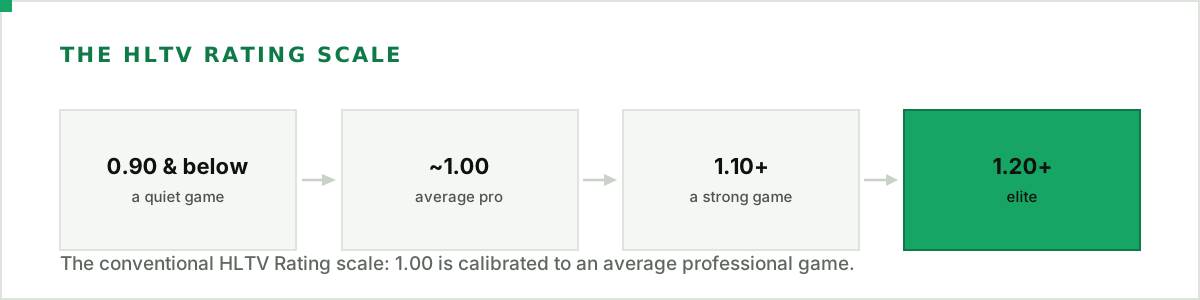
A 1.15 is a good night; 1.20 and above is elite territory; anything under 0.90 marks a quiet game. The rating exists because no single stat sees everything: raw kills overlook the player who trades and takes space, KAST is blind to how large those rounds were, and ADR says nothing about survival or clutch play. Rolling them into one weighted number captures more than any part alone. Because the scale is pinned to the average, a 1.20 reads as the same "clearly above average" for an entry fragger or an anchor, which keeps ratings roughly comparable across roles and eras.
The versions matter. Rating 2.0 (2017) became the modern standard; 2.1 recalibrated its weights for CS2; and Rating 3.0 (August 2025) was the biggest change since. It replaced the old "impact" component with Round Swing, which prices how much each kill shifts a team's chance of winning the round. Its six sub-ratings are Kills, Damage, Survival, KAST, Multi-Kills and Round Swing, with kills, damage and survival now weighted by the economy of each duel. HLTV's own Rating 3.0 adjustment notes record a later re-tune of those weights.
One thing to keep straight when you query it: a rating measures an individual's per-round impact, whereas a ranking orders teams (see VRS). And the rating field the API returns is our own computed figure, not HLTV's proprietary Rating. If you need HLTV's exact number, that stays on HLTV; what the API gives you is a clean per-match rating plus every underlying stat behind it, so you can audit it or build your own.
For the full derivation and what changed between versions, see HLTV Rating explained.