Entry frag in CS2, defined
An entry frag is the first kill of a round — the opening duel.
, 2 min read
It is the highest-leverage single event in a Counter-Strike round. The team that takes the opening kill plays the rest of it a player up, with the map control that follows: space to take, angles to hold, and information its opponents lack. That advantage is exactly what HLTV's Round Swing tries to price: the shift in round-win probability an action produces. The opening duel is among the largest swings on the board, which is why dedicated entry players exist despite carrying unflattering death counts.
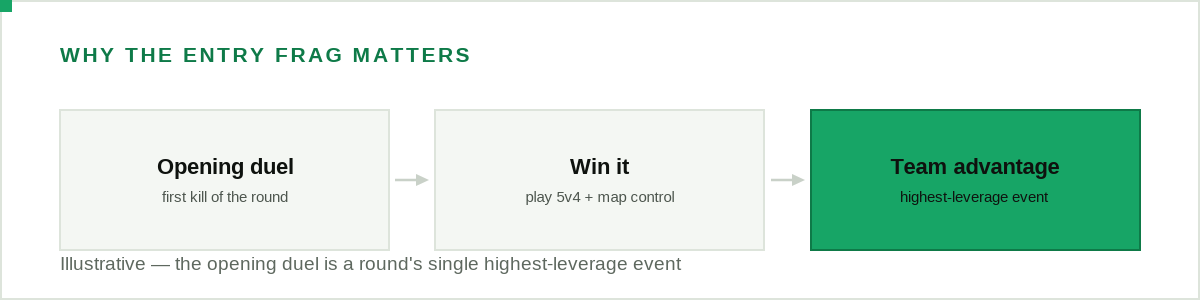
This is also why kill/death ratio undervalues entries. The entry fragger's job is to take a coin-flip duel first, so teammates play a 4v4 with information rather than a 5v5 blind. Losing that duel is often not a mistake. A good entry is not measured by winning every opener, which is impossible on a coin-flip, but by taking the right ones: duels where a teammate is set to trade, so even a loss converts into an even exchange rather than a lost round. Like a clutch, an entry's value is badly captured by a raw count.
How it is measured: the API exposes first_kills and first_deaths as counts per player-match, and both are nullable. They tell you how often a player entered and how often they died doing it, not the round-win probability that followed, which you would reconstruct from the round data yourself. A traded entry, meanwhile, still registers as a contribution, because KAST credits it.
The opening-duel counts sit in every match's box score: a measure of role and risk, not of a player's total value.
Start free with a sandbox key: a fixed sample of past matches, no card.