KAST is the percentage of CS2 rounds in which a player recorded a Kill, an Assist, Survived, or was Traded.
It answers one narrow question well: in what share of rounds did this player do something useful? A support player who survives to save a rifle, or who dies but is immediately traded, is contributing — and KAST is the common stat that says so. It is a named sub-rating inside modern composite ratings, including HLTV's Rating 3.0.
Across pro CS2 the values sit in a narrow band. In our data (N ≈ 205,595 performances) the 10th percentile is about 58%, the median about 72%, and the 90th percentile about 83%. Because the range is tight, small gaps matter: a player at 78% is meaningfully steadier than one at 68%. These are the measured percentiles, and they match the deep-dive and its benchmark chart.
How it is stored is worth knowing before you query it. The API returns kast as a fraction between 0 and 1 — multiply by 100 for a percentage — and the field is nullable, so some older or differently-sourced rows carry no value and should render as blank, not zero. A "trade" is also bounded by a time window, so KAST inherits whatever window the underlying stats apply.
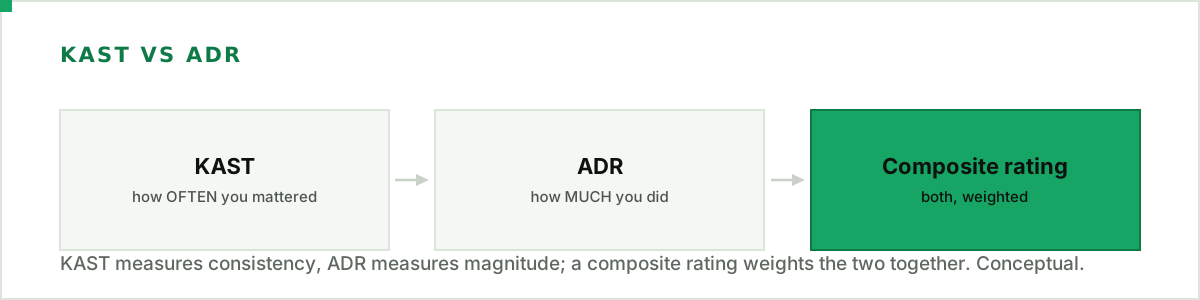
The trade-off is that KAST is blind to magnitude: a 1-damage assist and a clutch four-kill each count once, so a high KAST never proves a player carried a game, only that they kept showing up. That is deliberate. It measures consistency, which is why it pairs with ADR, the output stat, inside a composite rating.
See KAST in CS2 explained for how each of the four components is counted.