22,705 professional Counter-Strike matches are available through documented APIs as of mid-2026, but only providers with append-only historical odds and normalized schemas can support production-grade backtesting and fantasy models. The filter isn't whether an API has match data, it's whether the documentation is specific enough to keep your integration stable when live rosters, scores, and market lines all change at once.
| Provider Category | Markets Coverage | Odds History | Schema Quality | Update Model | Pricing | Best For |
|---|---|---|---|---|---|---|
| Market-price focused APIs | Strong on price snapshots and archives, narrow on match context | Good when archives are preserved, especially for replay and backtesting | Usually strong on market objects, weaker on player and tournament normalization | Mostly REST, sometimes hybrid | Often transparent, sometimes capped by request volume | Quant work, trading, odds replay |
| Comprehensive match-data platforms | Broad match, team, player, tournament, and odds context | Strong when capture history is append-only | Usually the best fit for stable identifiers and normalized records | REST plus push updates in some platforms | Typically subscription-based | Media, fantasy, dashboards, analytics |
| Community-built scrapers with public endpoints | Uneven, depends on maintainer focus | Often inconsistent or incomplete | Fragile, especially under live-match volatility | Polling-heavy and brittle | Cheap or free, but high maintenance | Prototypes, experiments |
| Traditional sports-api vendors with limited esports coverage | Narrow or shallow CS2 coverage | Usually thin | Often not designed for CS2 entity mapping | REST only, sometimes delayed | Familiar but not esports-native | General sports apps that need light CS2 support |
Table of Contents
- What CS2 API Documentation Means for Production Systems
- Seven Evaluation Criteria for CS2 Data APIs
- Comparing Major CS2 API Providers and Categories
- Integration Patterns for CS2 Data APIs
- Use Cases by Audience Profile
- Cost Analysis and Pricing Models
- Making Your CS2 API Selection
<a id="what-cs2-api-documentation-means-for-production-systems"></a>
What CS2 API Documentation Means for Production Systems
22,705 professional Counter-Strike matches are already available through documented APIs as of mid-2026, but raw access does not make an integration production-ready. The difference shows up in the documentation, not the marketing page. A mature cs2 api documentation set gives you explicit authentication, versioning, endpoint purpose, and schema shape, so your client does not break the first time a provider refactors a field or adds a new market object.
<a id="documentation-quality-beats-endpoint-count"></a>
Documentation quality beats endpoint count
The strongest example is a market-focused API that publishes a public base URL, requires an API key in the Authorization header for all /v1 requests, and separates live prices, short-term history, long-term archives, liquidity, and schema discovery into distinct endpoints. It also distinguishes endpoints like GET /v1/prices/latest, POST /v1/prices/history, and POST /v1/archive/history, which is the kind of separation that makes replay and backtesting possible without guessing how data is stored. Its docs also say live prices refresh every ~5 minutes, short-term history updates continuously from December 24, 2025 onward, and long-term archives reach back to 2023 onward (cs2.sh quickstart).
That pattern matters because it reflects a real contract, not a scraped feed. When I have built production systems, the fastest teams were not the ones with the most endpoints, they were the ones with the clearest schemas and version boundaries. Good API docs reduce integration ambiguity, and that is the difference between shipping a dashboard and babysitting a pipeline.
<a id="mature-specs-prevent-hidden-integration-debt"></a>
Mature specs prevent hidden integration debt
Documentation quality also means the provider has written down what client teams need to generate safe code. The clearest standard is OpenAPI 3 for REST or AsyncAPI 2 for event streams, with request and response schemas, header and path parameters, error models, allowed values, defaults, and examples fully defined (Siemens API specification guidance). Without that level of specificity, your integration becomes a series of assumptions about fields, nullability, and error behavior.
There is also a practical difference between a documented API and a documented product. Third-party CS2 docs often show match lists, live polling, webhooks, and archived resources, but they do not always explain how to handle missing fields or conflicting source data. That gap is especially painful in live esports, where a roster change or a delayed score update can ripple through every downstream consumer. For a useful companion view on operational live-data design, this esports live stats guide helps frame the update problem from the application side. For a second lens on presentation and update workflows, video documentation best practices is useful because it pushes teams to describe change handling in a way operators can follow.
Practical rule: if the docs do not tell you how to handle ambiguity, your application will invent a rule later, and that rule will eventually break.
The most productive mental model is simple. Endpoint count tells you what a provider can expose, but documentation quality tells you whether your team can trust the contract. A match-data platform with broad coverage may look attractive on paper, yet the decision comes down to whether the spec makes match records, player stats, team records, and odds usable together without custom glue at every integration point.
<a id="seven-evaluation-criteria-for-cs2-data-apis"></a>
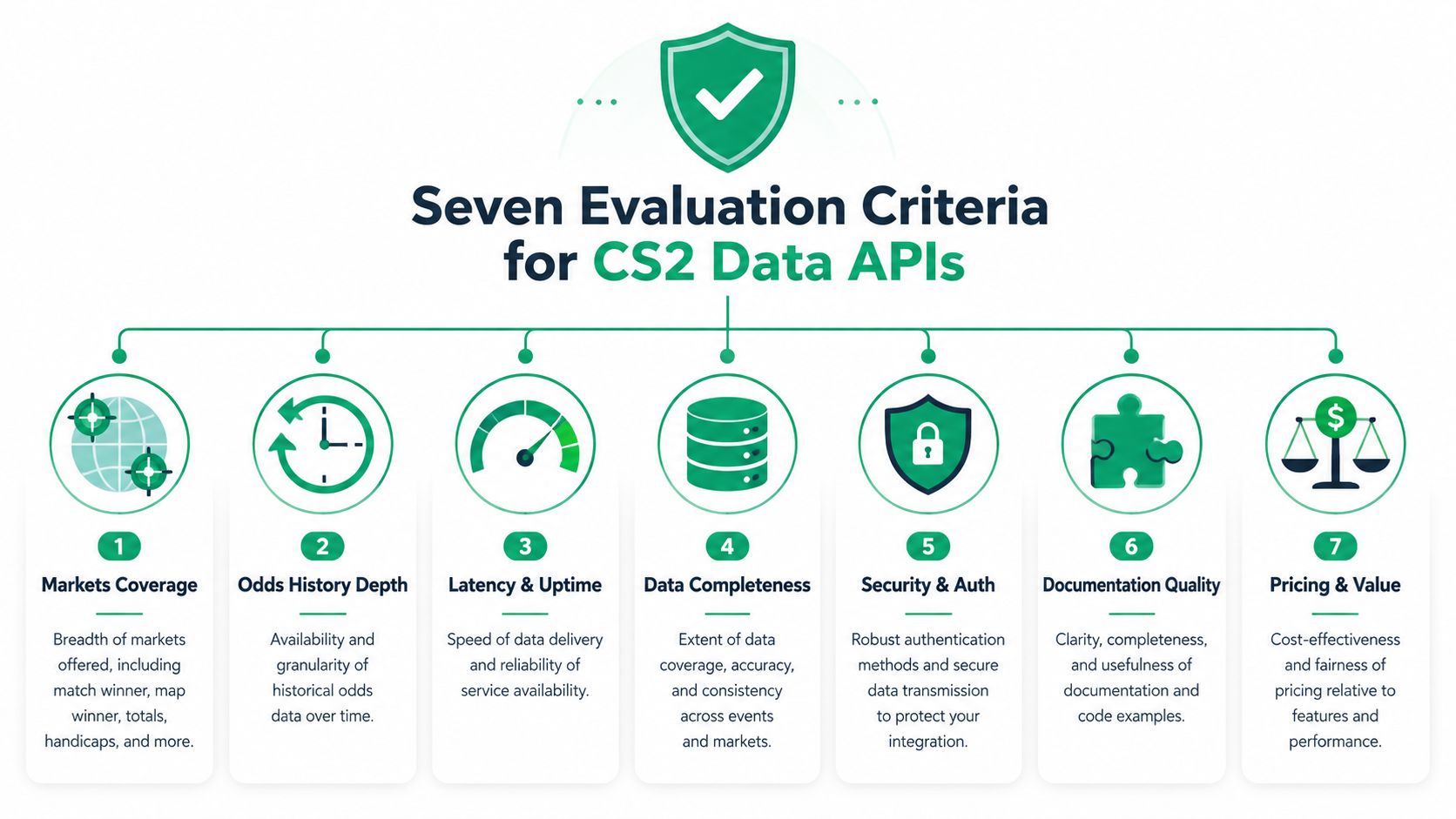
Seven Evaluation Criteria for CS2 Data APIs
<a id="markets-coverage"></a>
Markets coverage
Start by checking whether the provider covers the markets your product needs. Match winner alone is fine for a basic odds page, but production tools usually need map winner, totals, handicaps, and a way to reconcile market changes across a live match. If the docs only show one price object and no market taxonomy, you're going to spend engineering time inventing categories the API should have named.
<a id="odds-history-depth"></a>
Odds history depth
History is where the data becomes useful for backtesting and model training. The important question isn't whether a provider has a “history” endpoint, it's whether the documentation makes the history append-only and timestamped, or whether it looks like a rewritten snapshot feed. If the docs don't promise preservation, assume some line movement will disappear.
<a id="schema-normalization"></a>
Schema normalization
Stable identifiers are the hidden requirement that determines whether a CS2 dataset is reusable. A team ID, player ID, tournament ID, and match ID need to survive roster changes and season churn, or every consumer downstream has to patch the same mapping problem. When docs use names instead of identifiers, or change response shapes between endpoints, the integration cost goes up fast.
<a id="update-model-and-latency"></a>
Update model and latency
REST polling, WebSocket push, and hybrid architectures each solve different problems. Polling is easier to reason about, push is better for fresh state, and hybrid models usually win when you need both live updates and replayable history. If docs don't explain cadence, cache invalidation, and how updates are signaled, you're left guessing bandwidth costs and freshness.
<a id="reliability-and-access-controls"></a>
Reliability and access controls
Rate limits, request caps, and auth methods are not admin details, they define whether the API can support a real application. One provider in the market docs publishes 3 requests/day on free, 100 requests/day on premium, and unlimited on black-tier access, which makes the plan structure just as important as the endpoint list (Dathost CS2 match API introduction). If the documentation is silent on quotas, treat that as a risk, not a convenience.
<a id="pricing-transparency"></a>
Pricing transparency
A good commercial doc explains what happens when you scale. Hard caps, overage billing, trial length, and plan differences should all be written down clearly. If the vendor hides usage limits behind sales calls, your budget becomes a moving target.
<a id="legal-and-operational-fit"></a>
Legal and operational fit
Not every CS2 integration has the same compliance footprint. Media sites, fantasy products, betting-adjacent tools, and internal dashboards all face different exposure, and the docs should make those boundaries visible. If the product won't state how data is licensed, how long it's retained, or how replay access works, that's a sign the operational model is still immature.
The best CS2 APIs don't just expose data, they make failure states legible.
<a id="comparing-major-cs2-api-providers-and-categories"></a>
Comparing Major CS2 API Providers and Categories
The CS2 API market is easier to evaluate when the comparison starts with provider categories instead of brand names. Some services center on market pricing, some on match and tournament data, some are community scrapers, and some are general sports vendors that list esports without supporting it. The question is which category fits your data contract, your latency tolerance, and the amount of maintenance your team can absorb.
<a id="market-data-first-match-context-second"></a>
Market data first, match context second
Market-price focused APIs fit products built around odds movement, price archives, and replayable market history. cs2.sh is structured around live prices, short-term history, long-term archives, liquidity, and schema discovery, with a public /v1 structure and explicit authentication through the Authorization header. That shape works for trading, quant work, and any workflow that depends on price continuity.
The trade-off is context. A market-centric service can be strong on pricing and still thin on player, roster, and tournament data. That gap matters for media teams and fantasy products, because price alone does not explain why a line moved.
<a id="full-scope-match-platforms-reduce-glue-code"></a>
Full-scope match platforms reduce glue code
Match-data platforms sit on the other side of the trade-off. The documented CS2 match API from Dathost shows a more application-oriented structure, with POST /api/0.1/cs2-matches for match creation, GET /api/0.1/cs2-matches/{match_id} for live polling, and event webhooks after each round, match end, and kick event. The same provider family also exposes GET /api/v2/matches and GET /api/v2/upcoming_matches, with responses including teams, scores, event info, match kind, played date, and HLTV links.
That kind of documentation is better for systems that need a normalized view of the competition layer. It also shows the sort of plan logic teams should inspect early. Free access, low request quotas, and premium limits are operational signals, not marketing details.
<a id="scrapers-and-general-sports-vendors-look-cheap-until-they-dont"></a>
Scrapers and general sports vendors look cheap until they don't
Community-built scrapers can look attractive because they are cheap and quick to start. In production, they often become the most expensive option because they are brittle, hard to normalize, and rarely clear about missing fields or delayed updates. The documentation usually describes what is available now, not what happens when a tournament page changes structure.
Traditional sports API vendors are similar in a different way. They may advertise esports coverage, but the CS2 layer is often shallow, outdated, or missing the normalized team and player relationships modern applications need. That is acceptable for experimentation, but it is not enough for products that depend on stable IDs or live-state fidelity.
For teams comparing providers by integration burden as much as by feature list, EsportsOdds' guide to esports data API alternatives is useful because it frames the decision by category fit instead of isolated endpoints.
| Provider Category | Markets Coverage | Odds History | Schema Quality | Update Model | Pricing | Best For |
|---|---|---|---|---|---|---|
| Market-price focused APIs | Strong on prices and market objects | Strong if archives are append-only | Usually solid for market entities, weaker for broader match context | Mostly REST, sometimes hybrid | Often transparent, sometimes quota-based | Quant, trading, replay |
| Full-scope match-data platforms | Broad across matches, teams, players, tournaments | Useful when line history is retained | Usually strongest for normalized records | REST plus push/webhook updates | Subscription-based | Media, fantasy, dashboards |
| Community-built scrapers | Inconsistent by maintainer | Often incomplete | Fragile under live changes | Polling-heavy | Low upfront cost | Prototypes |
| Traditional sports vendors | Limited or shallow CS2 support | Usually thin | Not optimized for CS2 | REST only or delayed | Familiar pricing, limited fit | General sports apps |
<a id="integration-patterns-for-cs2-data-apis"></a>
Integration Patterns for CS2 Data APIs
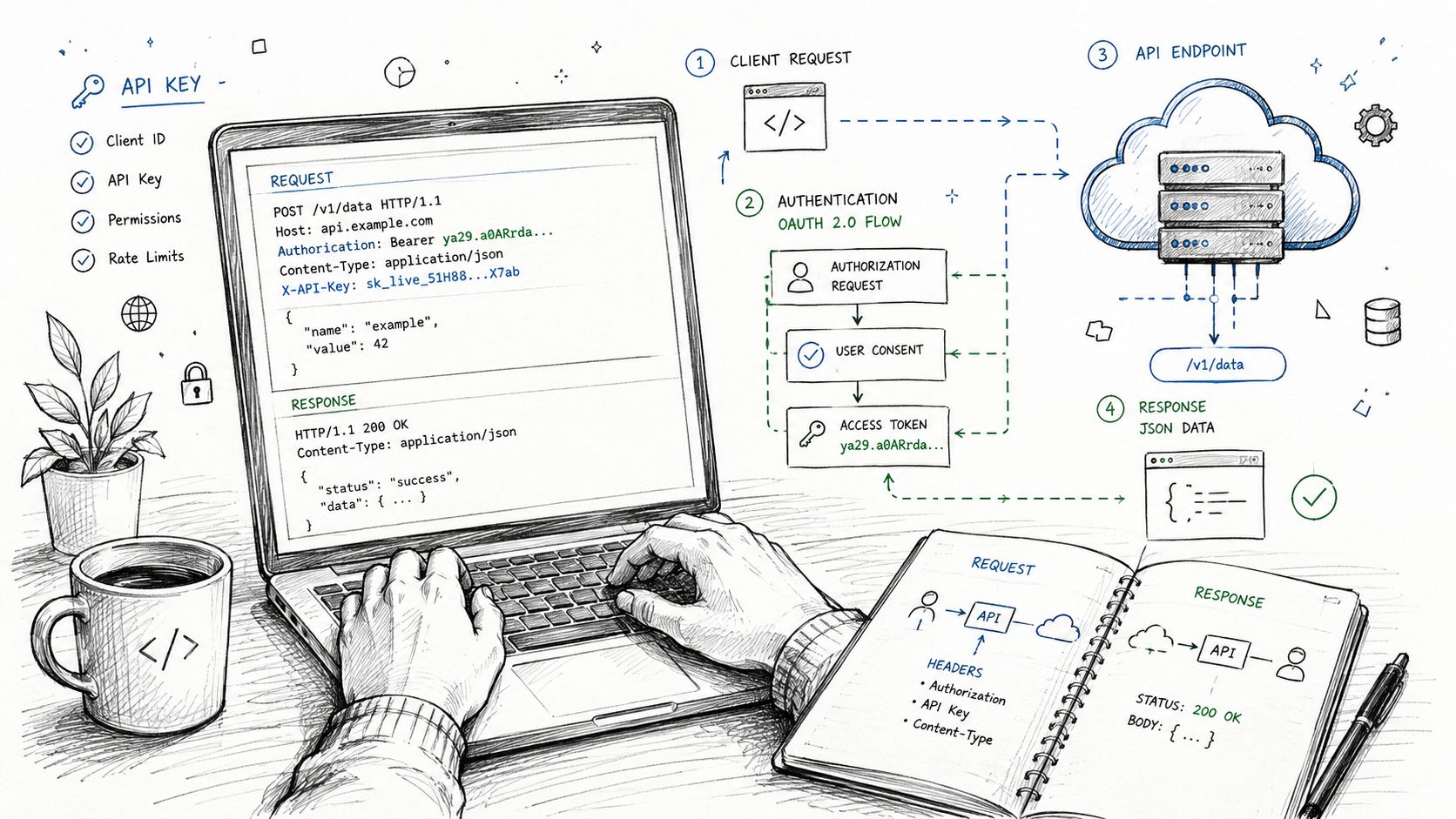
Authentication is the first place where a CS2 integration succeeds or fails. Some providers use API keys in headers, others use short-lived tokens for WebSocket access, and some require both depending on the resource. The important part is not the mechanism itself, it's whether the docs make the lifecycle explicit enough for your client to renew, retry, and fail closed.
<a id="build-the-rest-layer-around-stable-filters"></a>
Build the REST layer around stable filters
For REST endpoints, treat filterable parameters as part of your contract, not convenience features. If the provider exposes endpoints for matches, players, teams, or tournaments, parse responses into your own normalized objects immediately instead of passing raw JSON through your app. That keeps response drift local and makes your downstream code independent from provider naming quirks.
A practical pattern is to poll for slow-changing resources and cache aggressively, then invalidate only the affected objects when a live update arrives. That's especially useful when your UI needs current scores but your backend also stores historical match context. The hybrid model in the publisher's docs is built for exactly this, combining frequent polling with WebSocket notifications so clients can re-pull only updated resources.
<a id="use-push-events-for-what-changes-fast"></a>
Use push events for what changes fast
WebSocket or webhook streams are the right choice for live state, but only if the docs tell you how tickets, subscriptions, and replays work. The documented CS2 pattern from EsportsOdds uses a short-lived /v1/cs2/ws-token endpoint to mint access for the live stream, then notifies clients when lines or scores change so the application can fetch just the affected data. That keeps bandwidth down and avoids hammering the same endpoint for every front-end refresh.
The operational rule is simple. Use push for change detection, not as your only source of truth. Keep the REST layer as the canonical read path so you can replay state, recover from missed messages, and reconcile client caches after a disconnect.
Production habit: if a live event can't be replayed from stored history, treat it as a monitoring signal, not a durable data source.
For implementation detail on the live-update side, the CS2 match updates WebSocket guide is a sensible reference point because it shows how update channels and pull-based recovery fit together.
<a id="use-cases-by-audience-profile"></a>
Use Cases by Audience Profile
Esports media teams, fantasy operators, traders, and independent analysts all want CS2 data, but they don't want the same contract. The mistake I see most often is buying for the use case you imagine instead of the one your product serves. A stats site, a prediction engine, and a trading desk all fail for different reasons, so they need different documentation strengths.
<a id="media-and-statistics-websites"></a>
Media and statistics websites
Media teams need normalized match data, team and player records, stable identifiers, and predictable uptime. They also care about editorial reliability, which means the docs need to support fixtures, recaps, and live scores without forcing reporters to patch entity names by hand. The best fit here is usually a match platform or a hybrid provider that also exposes market context.
<a id="fantasy-and-prediction-platforms"></a>
Fantasy and prediction platforms
Fantasy and prediction products care about append-only odds, roster continuity, and low-latency updates during live play. If the documentation doesn't preserve historical prices or explain how reclassified players are handled, model training becomes noisy fast. These teams should prioritize a provider with stable IDs, a timestamped odds stream, and a clear replay story.
<a id="trading-desks-and-quant-teams"></a>
Trading desks and quant teams
Quant teams should optimize for market integrity first. Timestamped price history, reconcilable market lines, and clear archive semantics matter more than broad content coverage. A market-focused API can be ideal here, as long as the docs guarantee schema stability and preserve the historical sequence instead of overwriting it.
<a id="independent-bettors-and-analysts"></a>
Independent bettors and analysts
Solo analysts usually need access, clarity, and cost control before anything else. They don't want enterprise sales processes, but they do need enough schema discipline to avoid building models on inconsistent data. For this audience, the documentation has to be readable enough to implement quickly and strict enough to trust.
The one EsportsOdds-shaped fit in this category is a developer who wants a normalized CS2 API with REST and WebSocket access, plus a reconciled odds line and append-only historical captures. That profile benefits from a single provider that keeps match, team, player, and tournament records aligned with market data, rather than stitching together separate feeds.
<a id="cost-analysis-and-pricing-models"></a>
Cost Analysis and Pricing Models
Pricing is where CS2 API choices become real. A vendor can look cheap until you add retries, history pulls, backfills, and live polling during a busy match window. The right way to think about cost is total ownership, not just the monthly fee.
<a id="hard-caps-change-the-economics"></a>
Hard caps change the economics
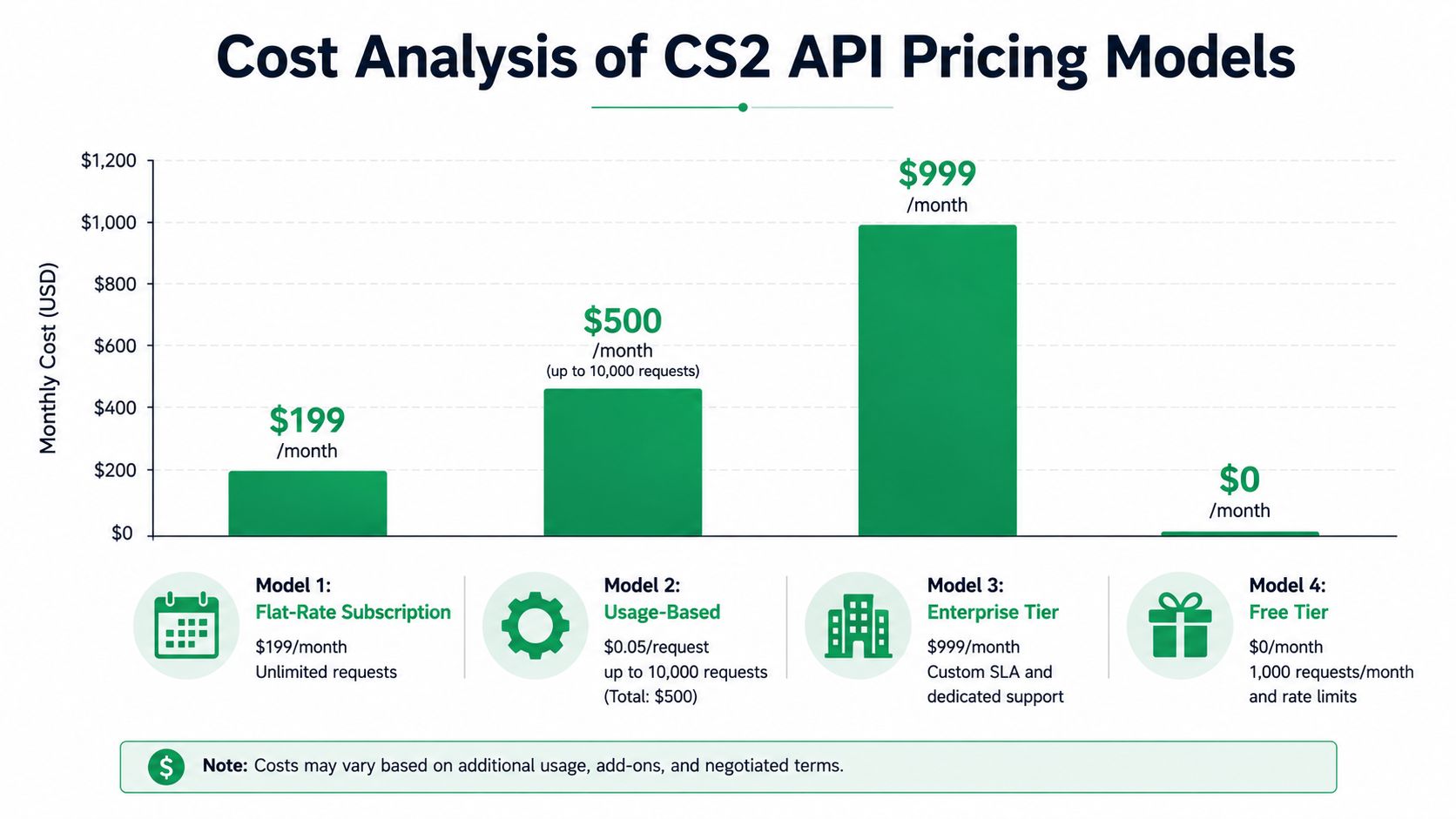
One provider in the product brief uses a single plan at $49/month for 50,000 requests with a hard cap, HTTP 429 once you exceed quota, and no overage billing. That's clean from a budgeting perspective because the ceiling is obvious, but it means your architecture has to be efficient from day one. Another documented provider tiers access from 3 requests/day on free to 100 requests/day on premium, with unlimited access on a higher tier (Dathost CS2 match API introduction).
Those two models serve very different buyers. The first rewards predictable workloads and strong caching. The second is useful for evaluation, but severe rate limits make it a poor fit for anything with live refresh needs.
<a id="model-the-hidden-costs-too"></a>
Model the hidden costs too
Request pricing is only part of the bill. Engineering time spent normalizing schemas, reconciling missing fields, and patching brittle endpoint changes is often more expensive than the subscription itself. That's why append-only history and documented schemas matter so much, because they lower the maintenance cost that sits outside the invoice.
For a broader framing on how to think about infrastructure cost beyond the subscription fee, cut cloud TCO with Server Scheduler is a useful lens, even though the subject there is general ownership economics rather than CS2 specifically.
<a id="match-the-model-to-the-workload"></a>
Match the model to the workload
A small analyst tool might survive on a free or low-cap tier if it only refreshes a few times per day. A media property or odds dashboard needs enough request headroom to support live coverage and historical backfills. Trading systems and broader analytics stacks should assume that the cheapest plan is usually the most expensive once maintenance and missed coverage are factored in.
If your product depends on live freshness and replay, a low sticker price can hide the highest integration cost.
<a id="making-your-cs2-api-selection"></a>
Making Your CS2 API Selection
Choose the provider category that matches the data contract you need. If your product is odds-heavy, prioritize archive depth, stable schemas, and append-only pricing history. If your product is editorial or fantasy-oriented, prioritize normalized match, player, and tournament data with strong live update support.
The easiest mistake is optimizing for endpoint count. A provider with a smaller, well-documented surface can outperform a larger one if it gives you explicit auth, versioning, and error models. The second mistake is trusting a free tier that doesn't document schema behavior under live volatility, because the time you save on signup comes back as maintenance work later.
Use a short checklist before you commit:
- Schema clarity: does the docs page define request and response shapes, errors, and allowed values?
- Identity stability: do team, player, tournament, and match IDs stay consistent across seasons?
- History preservation: does the provider keep odds or state changes append-only, or does it overwrite them?
- Update model: is there a clean way to combine polling with push notifications?
- Cost controls: are caps, trials, and rate limits written down clearly?
- Operational fit: does the product line match your actual audience, not just esports in general?
If you're building a CS2 dashboard, odds model, or match service and want a provider built around normalized data, append-only history, and live updates, take a look at EsportsOdds. It's worth testing against your own use case, because the right API choice is the one that keeps your integration stable after the first live match, not the one that looks broadest in a feature list.