Bottom line: Almost every no-vig calculator hardcodes one method — multiplicative, and never tells you. On a coin-flip market that is fine, because all four methods agree exactly. On a heavy favourite they disagree by 2.41 percentage points on the longshot, which is the difference between a fair price of +450 and +534. This page compares all four on the same prices; the no-vig calculator computes them side by side so you can see the spread on your own numbers.
The four methods
All four start from the same place, raw implied probabilities that sum to more than 100%, and differ only in how they take the excess out.
Multiplicative divides every probability by the booksum. One division, proportional, and the default nearly everywhere. It assumes each outcome carries margin in proportion to its own probability.
Additive subtracts the same amount from every outcome: the margin split evenly, in percentage points. Because it removes an equal absolute amount, it takes proportionally far more from a small probability than a large one.
Power raises each probability to a power k, where k is solved numerically so the results sum to exactly 1. On a market with margin, k is slightly above 1, which shrinks small probabilities more than large ones. It is a gentler version of what additive does.
Shin comes from a different idea entirely. Rather than treating the margin as a flat cut, it models it as protection against participants who know more than the market does, and solves for z, the implied proportion of that better-informed money. It is the method most often cited in academic work on the favourite–longshot bias.
How much the choice is worth
Here is the same question, asked of five market shapes from a coin flip to an extreme favourite: what is the longshot's fair probability?
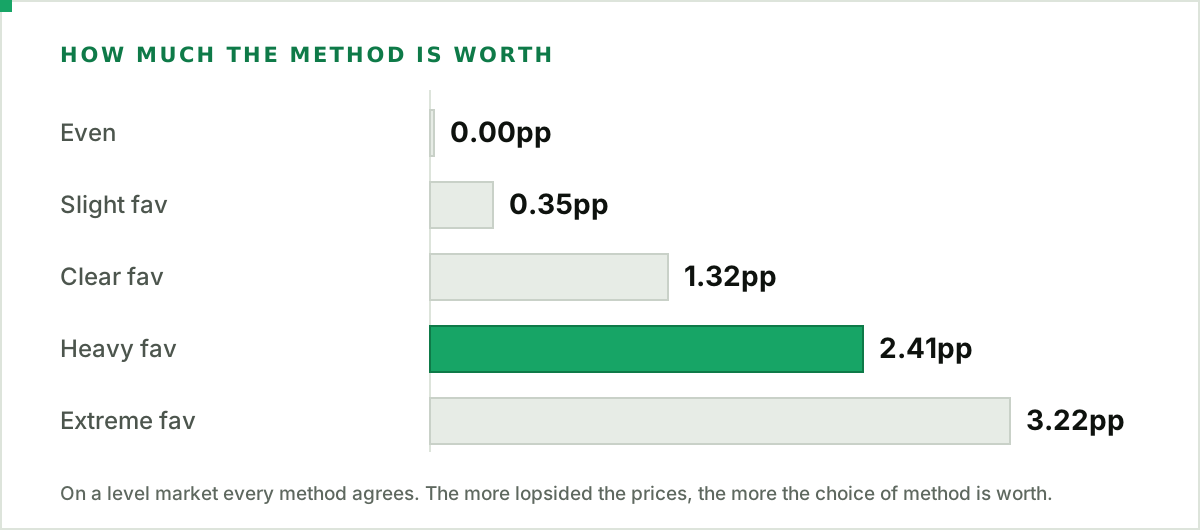
On a level market the methods agree to the last decimal, so the choice is irrelevant. The spread grows with the imbalance, and by the time a market is priced −1500/+800 the four methods span 3.22 percentage points on the longshot.
Taking the heavy-favourite case (−600/+425) in detail: multiplicative returns 18.18% for the longshot, additive and Shin both return 16.67%, and power returns 15.77%.
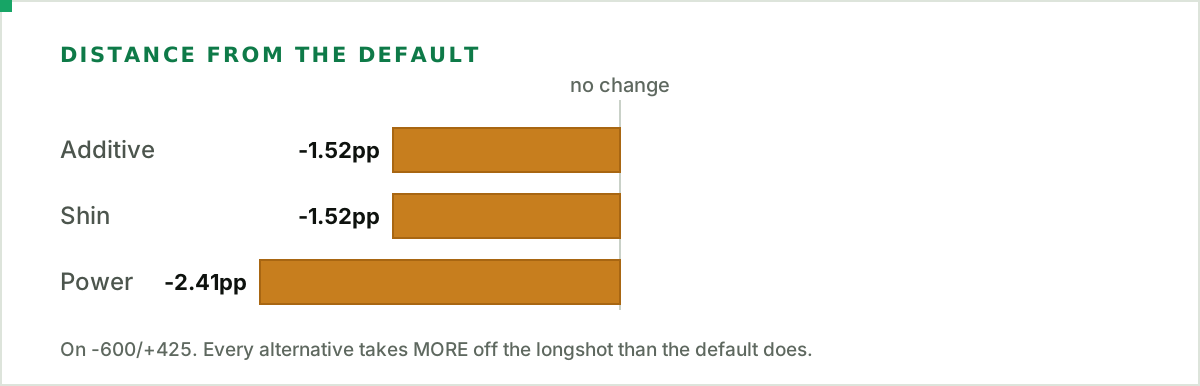
The direction is consistent. Every alternative takes more off the longshot than multiplicative does, which is the favourite–longshot bias made concrete: if you believe long prices are systematically too generous relative to their true chance, multiplicative is the method that flatters them most.
Additive and Shin are the same method on a two-way market
That is not a coincidence of the prices above. On any market with exactly two outcomes, additive and Shin return identical numbers.
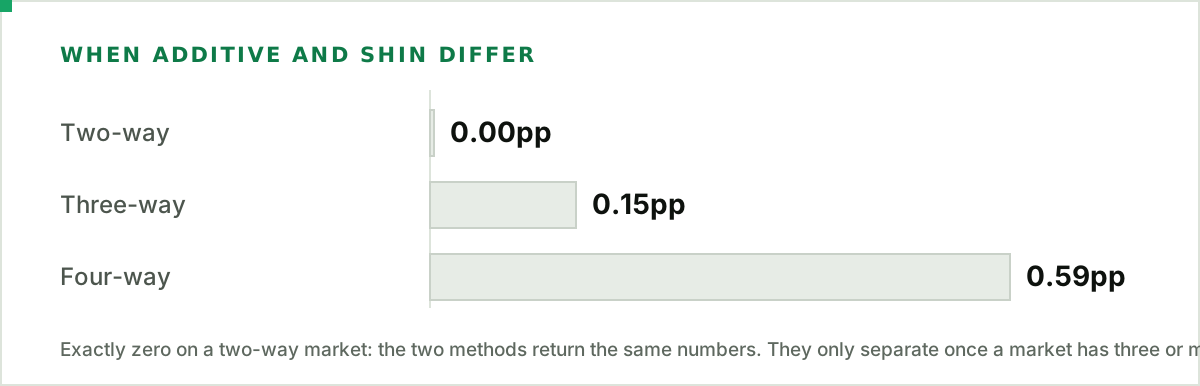
They separate only once a third outcome exists, and even then modestly: about 0.15 points on a typical three-way market and 0.59 on a four-way. The practical consequence is worth stating plainly. If you only ever de-vig match-winner markets, you have three distinct methods available, not four, and picking between additive and Shin is a choice with no effect.
When a method has no answer
Additive can fail. Because it subtracts the same absolute amount from every outcome, a heavy longshot in a wide market can be pushed to zero or below, and a non-positive probability has no fair price at all.
A three-way market priced 1.02 / 40 / 60 is the clean example. Multiplicative handles it (95.92% / 2.45% / 1.63%); additive would drive the outcomes below zero, so the honest answer is that the method does not apply here. Our calculator returns nothing in that case rather than printing a number that looks fine and is not.
Which one should you use?
None of them is correct, and that is not a dodge. They are four different assumptions about where margin sits in a market, and which fits best is an empirical question that depends on the sport, the market type and the source. What you can do is bound your uncertainty: run all four, and if they agree, the choice does not matter. If they span two percentage points, you have learned something useful about how much of your number is assumption rather than data.
Multiplicative is a reasonable default, and it is what we use for the single CS2 market line we publish — documented in the methodology. For the arithmetic underneath, see how to remove the vig from odds; for the concepts, the vig explained and the glossary entry for de-vigging.