De-vigging removes the vig from a set of odds, so the implied probabilities sum back to exactly 100%.
The simplest method — proportional normalisation — divides each outcome's implied probability by the market total. If a market implies 55% and 50% (105% together), the de-vigged fair probabilities are 55 / 105 = 52.4% and 50 / 105 = 47.6%.
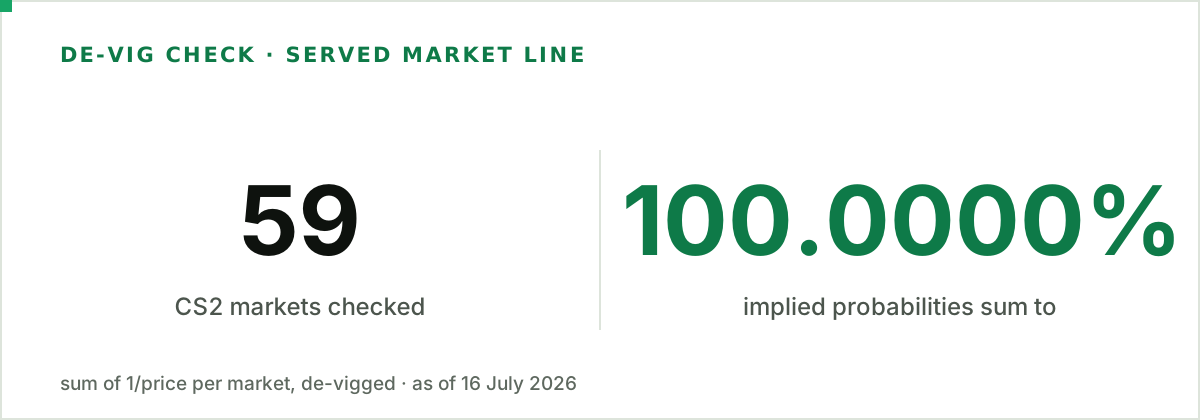
What remains is the market's genuine estimate, stripped of margin, and therefore directly comparable against your own model or against another market. The gap between the raw total and 100% is the overround — the margin itself — and de-vigging is the step that removes it, so two markets priced with different margins can be read on one scale. That "sums to 100%" property is not just theory: across the 59 CS2 match markets our line served on 16 July 2026, the de-vigged implied probabilities summed to exactly 100.0000%, the margin fully removed, every time.
Proportional normalisation is the workhorse, but it carries an assumption: it spreads the margin evenly across outcomes, which tends to overstate the true chance of short-priced outcomes and understate long-shots. More elaborate models exist; the standard academic treatment of turning betting odds into calibrated probabilities is Štrumbelj (2014), which tests these approaches against realised results.
Doing this across a whole schedule is what a derived market line automates: de-vig each contributing source, then take the median across them, so no single stale or wide-margin source can skew the consensus. No individual source is ever named, and no per-book price is ever served, only the aggregate.
Read the methodology behind the served line, or the vig explained: how de-vigging finds fair odds for the arithmetic and its limits.
To do it on your own numbers, the free no-vig calculator removes the margin by four different methods — multiplicative, additive, power and Shin — side by side.