Bottom line: Three systems rank professional CS2 teams, and they don't always agree. Valve Regional Standings (VRS) is the official points system that decides Major invites: it rewards prize money won, the quality of teams you beat, and recent LAN results. The HLTV world ranking is the editorial, achievement-based community standard, and ELO is the general "who would win the next match" idea both borrow from. This guide explains how each is built, grounded in team-strength data from the EsportsOdds CS2 data API.
Three systems, three philosophies
There is no single "CS2 ranking." There are three, each answering a slightly different question:
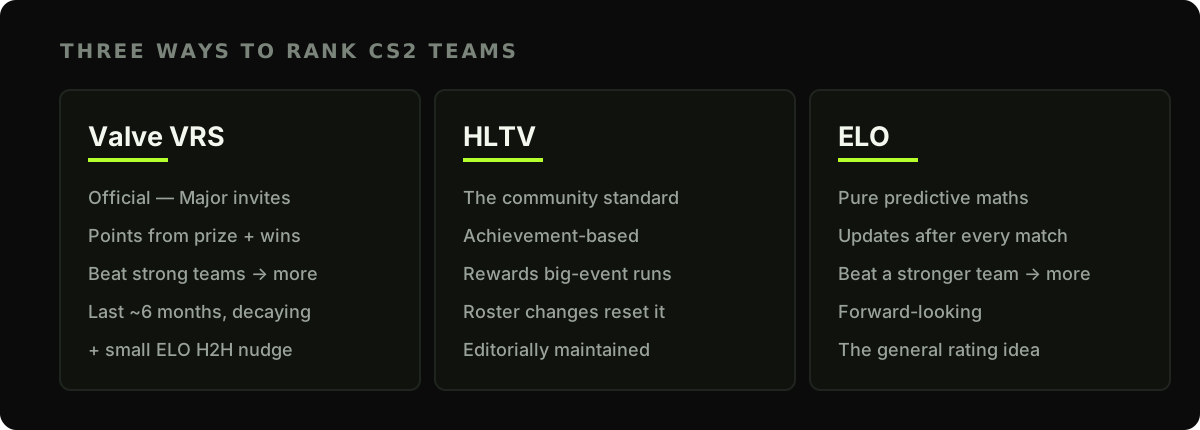
- Valve Regional Standings (VRS) is the official ranking, and the one that actually decides who gets invited to the Majors. It is a points system, not a black box. Valve publishes the VRS code itself, so the recipe is source-available rather than reverse-engineered. A team's score is built mainly from four things: the prize money it has won (on a logarithmic scale, so a $1M win isn't worth 1,000× a $1k one), the prize money of the teams it has beaten, the number of distinct strong opponents it has beaten, and its recent LAN results, all decaying over roughly a six-month window. A small head-to-head adjustment, ELO-style, nudges the result based on direct matchups. It updates weekly. Because so much of it is prize-and-results weighted, VRS rewards big-event success heavily.
- The HLTV world ranking is the community standard, and more editorial. It rewards deep runs at big events, is sensitive to roster changes (a new lineup effectively resets a team's standing), and tries to capture "how good is this team right now," reflecting prestige and achievement. It's the ranking fans argue about.
- ELO is not really a public CS2 leaderboard. It is the general idea underneath rating systems everywhere (chess, football, matchmaking): forecast who wins the next match, and update after every result. VRS borrows an ELO-style head-to-head term; a pure ELO would be the most forward-looking of the three.
Those four inputs dominate VRS, and the ELO-style term is genuinely small next to them:
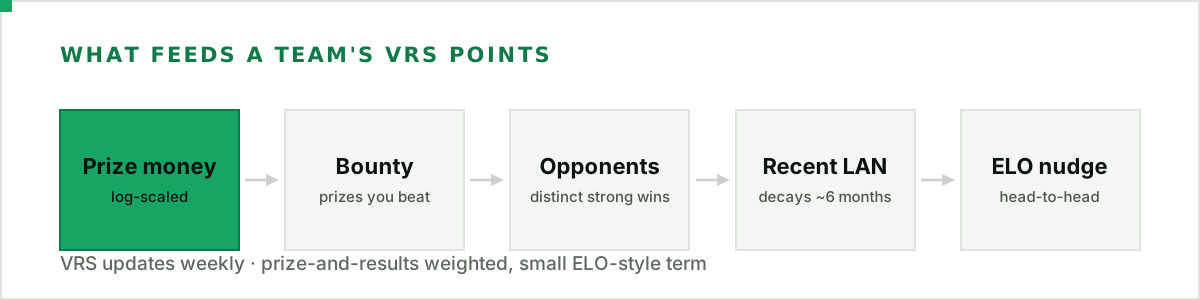
The disagreements are the interesting part. A team that just won a big event climbs both rankings for different reasons: HLTV credits the achievement, VRS the prize money and the scalps. A steady team that beats good opponents without a trophy can still climb VRS through Bounty Collected. Neither is "wrong"; they weigh the same evidence differently.
The idea behind ELO
ELO is the cleanest mental model for "team strength," and VRS borrows a piece of it. Every team has a rating, and after each match the winner takes points from the loser. The twist is that how many points depends on who you beat:
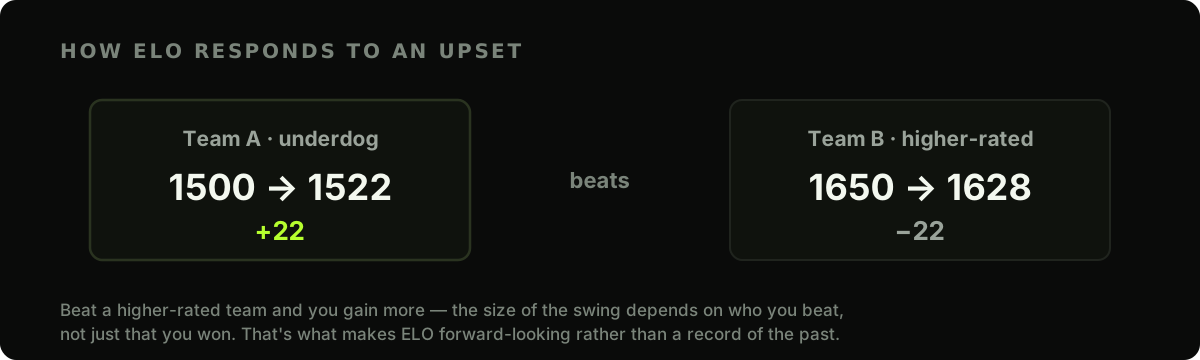
Beat a team rated far above you and you gain a lot; beat an expected win and you gain little. That's what makes a pure ELO forward-looking: it tracks who wins the next match, rather than tallying past achievements. VRS uses it only as a head-to-head adjustment on its prize-and-results core, which is why a team can bank a high VRS on prize money through a rough run.
What a ranking has to capture: the spread of team strength
A ranking is only interesting because teams genuinely differ in strength. Across the 504 teams with at least 20 maps in our dataset (as of 16 July 2026), map win rates spread out like this:
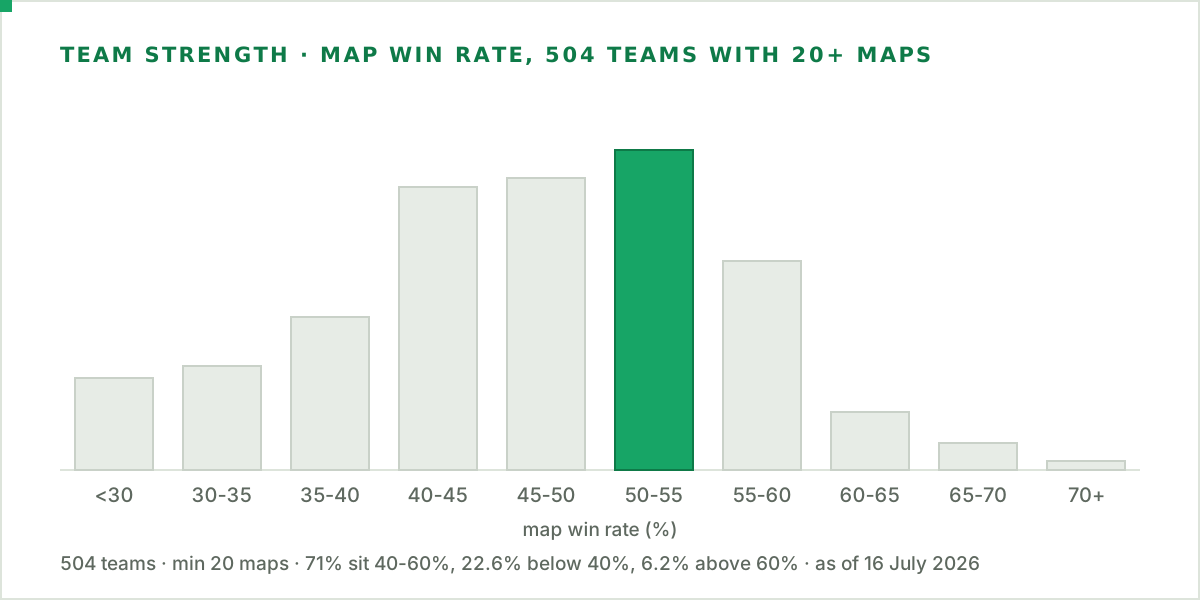
The shape is telling. 71% of teams sit between 40% and 60%, the broad middle of professional Counter-Strike, where results are close and rankings churn. The action is in the tails: only 6.2% clear 60% (31 teams), the elite a good ranking has to separate out, while 22.6% fall below 40% (114 teams). A ranking earns its keep by ordering that congested middle correctly and identifying who really belongs at the top, which is why recency, opponent strength and sample size matter so much. It's also why the map veto is a strong pre-match signal: two closely-ranked teams are often separated by which maps they force.
How EsportsOdds ranks teams
EsportsOdds computes its own team and player rankings: a Glicko-2 rating derived from match results, ordered on a conservative estimate (the rating minus twice its uncertainty) with a minimum-sample floor, so a team can't top the table off three lucky games. The exact method is documented, not asserted, and it's labelled as our own metric, not a copy of Valve's or HLTV's. It's a clean, queryable ranking developers can build on, browsable on the CS2 team rankings.
Every team's ranking, plus head-to-head records, recent form and match history, is available through the EsportsOdds CS2 data API as JSON. It's what you'd build a ranking tracker, a strength-of-schedule model, or a match preview on.
Valve Regional Standings is the official points system for Major invites: it rewards prize money, the teams you've beaten and recent LAN wins, with a small ELO-style head-to-head nudge. The HLTV ranking is the editorial, achievement-based community standard. ELO is the general "predict the next match" idea both borrow from.
Frequently asked questions
What is the Valve Regional Standings (VRS)?
The official CS2 ranking that decides Major invites. It's a points system built mainly from prize money won (log-scaled), the prize money of teams beaten, the range of strong opponents beaten, and recent LAN results, with a small ELO-style head-to-head adjustment. It updates weekly.
What's the difference between the VRS and the HLTV ranking?
The VRS is Valve's official points system for Major seeding, weighted toward prize money and results. The HLTV ranking is the community-standard, editorial one that leans on big-event achievement and resets on roster changes. A team can rank differently on each because they weight prize money, opponent quality and prestige differently.
Is the VRS based on ELO?
Not really. VRS is a prize-money-and-results points system; it uses an ELO-style head-to-head adjustment as one small term, but its core is prize money won, teams beaten and LAN results, not a pure ELO rating.
How does ELO work?
Every team has a rating; after each match the winner gains points and the loser loses them, with the amount depending on the rating gap. Beating a higher-rated team earns a bigger jump. It's the forward-looking idea VRS borrows a piece of.
Where can I get CS2 team ranking data via an API?
The EsportsOdds CS2 data API serves its own team and player rankings, plus head-to-head records and full match history, as JSON on a flat $49/month plan. That's enough to rebuild a strength-of-schedule model or wire a power ranking into your own app.
Cite this
EsportsOdds, "How CS2 rankings work: Valve VRS, HLTV and ELO", 10 July 2026. https://esportsodds.gg/learn/cs2-rankings