The global esports audience reached about 640.8 million viewers, and trackers have already cataloged 81,919 tournaments and 343,649 matches in the cited industry summary. That scale changes the job of a League of Legends pro stats pipeline. A feed isn't just carrying match results, it's normalizing rosters, events, timestamps, and live state across a crowded, fast-moving ecosystem where small data mistakes get amplified quickly.
A production-grade esports data feed for LoL has to do more than expose JSON. It needs stable identifiers, a canonical entity layer, low-latency updates, and a history model that lets analysts replay the market or the match state later. If the feed can't reconcile team names, preserve prior values, and separate snapshots from streaming updates, it won't hold up under analytics, fantasy, or trading use cases.
Table of Contents
- Introduction to Esports Data Feed for LoL Pro Stats
- Key Categories of LoL Pro Stats Metrics
- Detailed Definitions of Core Metrics and Derived Indicators
- API Endpoints for LoL Pro Stats with Examples
- Data Normalization and Stable Identifier Strategies
- Use Cases for LoL Pro Stats Data Feed
- Best Practices for Integration and Visualization
- Cross References and Data Dependencies
- Quick Reference Tables for Metrics and Endpoints
- Related Resources and Glossary
<a id="introduction-to-esports-data-feed-for-lol-pro-stats"></a>
Introduction to Esports Data Feed for LoL Pro Stats
A useful LoL feed starts with a simple idea, every object in the system should mean the same thing every time it appears. That sounds obvious until you start pulling from multiple upstreams and discover that team labels change, player tags drift, and a match can carry slightly different metadata depending on where it was sourced. Once that happens, the feed stops being a clean delivery layer and becomes an entity-resolution problem.
The market context matters here. A recent sports-betting data feeds report places the category at $1.49 billion in 2025, while esports forecasts point to expansion from about $2.64 billion in 2025 to $12.0 billion by 2033 in the market report. That's why the design choices around REST snapshots, WebSocket updates, and historical retention are no longer optional plumbing decisions. They're the difference between a feed that supports live operations and one that only looks good in a demo.
Practical rule: if a feed can't tell you what changed, when it changed, and which upstream source it came from, it's not ready for production use.
For League of Legends specifically, that pressure shows up in roster churn, patch-driven meta shifts, and frequent dependencies on tournament context. A serious integration needs to balance low-latency delivery with queryable history, because editors, analysts, and model builders don't all ask the same question at the same moment. Some want the current match state, some want a replayable event log, and some want clean season-long reference data.
That's the lens for the rest of this guide, production design first, metric definitions second, and integration choices third.
<a id="key-categories-of-lol-pro-stats-metrics"></a>
Key Categories of LoL Pro Stats Metrics
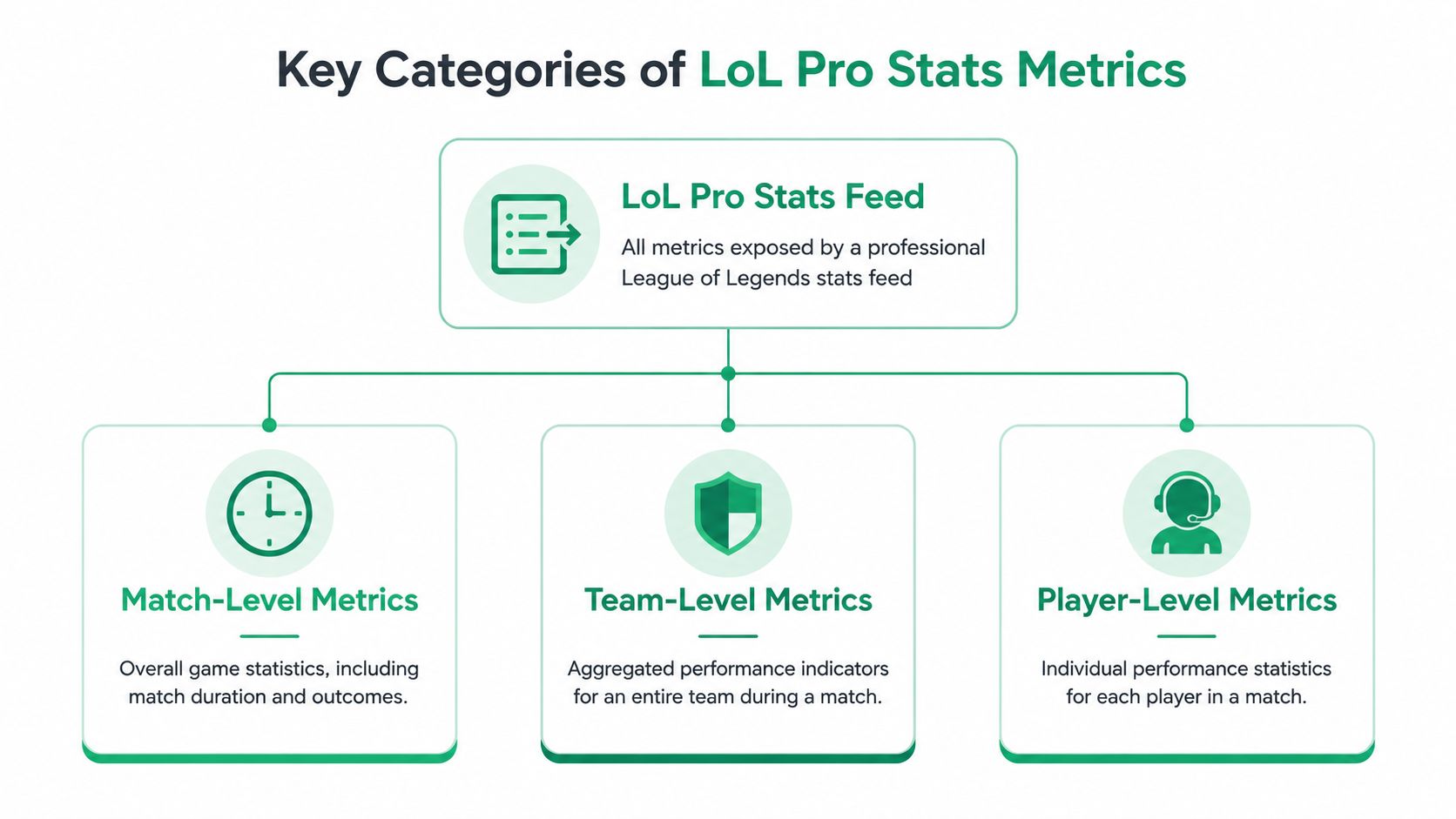
A LoL pro stats feed works best when the metrics are grouped by the level at which people use them. Match-level numbers help you understand game flow. Team-level numbers show coordination and macro strength. Player-level numbers let you compare roles, lane pressure, and execution without collapsing the whole roster into one average.
<a id="match-level-metrics"></a>
Match-Level Metrics
Match-level data is the cleanest place to start because it anchors everything else. Match duration, objective capture times, and final outcomes tell you how the game unfolded in time. In editorial workflows, these numbers support recaps and timeline visualizations. In operational workflows, they're the first signals used to validate whether the feed is publishing a complete event state.
<a id="team-level-metrics"></a>
Team-Level Metrics
Team-level metrics show collective behavior, not just final scorelines. Win rate, objective conversion, draft or composition efficiency, and aggregate economy signals help analysts compare style across squads. These metrics are especially useful when a team's roster changes mid-season, because the unit-level view often reveals whether the system or the players changed first.
<a id="player-level-metrics"></a>
Player-Level Metrics
Player-level metrics are the most granular and usually the most misunderstood. Kills, assists, creep score, damage per minute, and vision-related numbers all tell different parts of the same story. Fantasy platforms lean on these numbers for scoring, while analysts use them to separate good lane control from merely good team results.
The practical benefit of the three-bucket model is that it prevents a feed from becoming a pile of unrelated fields. Each metric domain can be validated on its own, queried on its own, and visualized on its own. That keeps downstream systems simpler, especially when the same match has to power a dashboard, an article, and a model.
<a id="detailed-definitions-of-core-metrics-and-derived-indicators"></a>
Detailed Definitions of Core Metrics and Derived Indicators
The hardest part of metric design is not naming the fields. It's making sure every consumer knows whether a field is raw, derived, or inferred. If you don't separate those layers, people will compare incompatible values and blame the feed when the underlying issue is their assumption.
<a id="core-match-metrics"></a>
Core match metrics
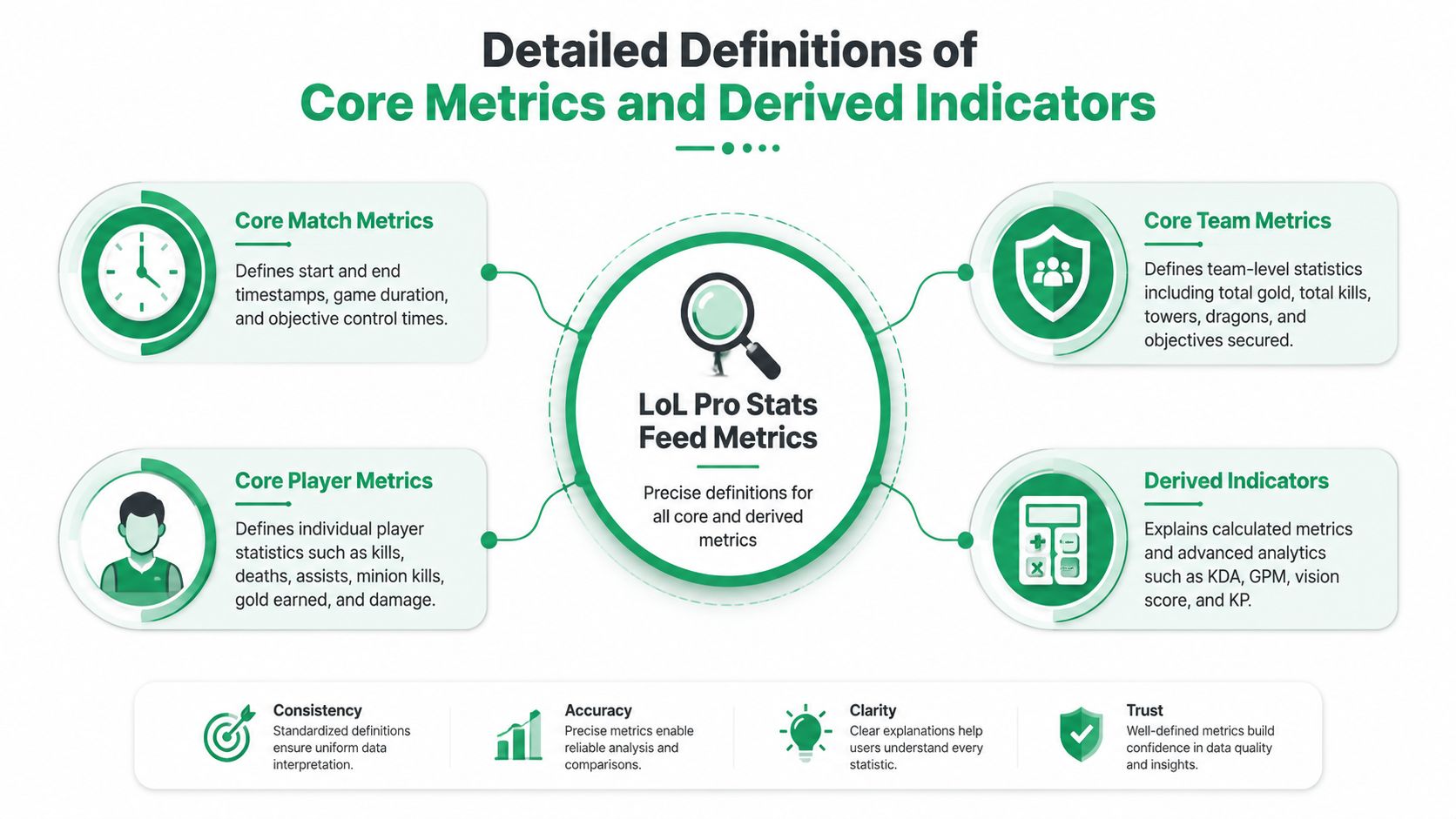
A start timestamp marks the moment the match becomes live in your system, while the end timestamp marks verified completion. Objective control times refer to when major in-game objectives are secured and recorded in the event log. A game pace index is a derived pacing view, not a raw observation, so it should always be treated as a calculated indicator rather than source truth.
The cleanest implementation is to preserve the event stream and calculate rollups from that stream, not the other way around. That way, when a correction arrives, you can rebuild the metric from source events instead of patching a broken aggregate by hand.
<a id="core-player-metrics"></a>
Core player metrics
For a player, kills, deaths, and assists should remain atomic counts. KDA ratio is derived as (kills + assists) / max(1, deaths), which avoids division by zero while preserving interpretability. Damage per minute is total damage divided by match minutes, and vision score should stay explicit about whether it's sourced as provided or recomputed from underlying actions.
Don't bury formulas inside documentation that nobody reads. Put them beside the field definition or in the schema registry, then keep the raw events available for audit.
<a id="derived-indicators"></a>
Derived indicators
Derived indicators are where teams often overreach. Gold per minute is useful because it normalizes economy across different match lengths, but it only works if the feed preserves the exact duration used in the denominator. The same applies to any pick-ban influence score, which should be clearly labeled as calculated so it doesn't get mistaken for a direct in-game event.
A practical test is to take one match, replay the raw event log, and manually rebuild a handful of values. If the numbers don't match the published payload, the issue is usually either a missing event, a bad timestamp normalization, or a field that was derived too early in the pipeline. That's the sort of validation that catches hidden drift before users do.
<a id="api-endpoints-for-lol-pro-stats-with-examples"></a>
API Endpoints for LoL Pro Stats with Examples
A production esports data feed usually needs two surfaces. A normalized REST layer handles schema checks, historical replay, and client-driven queries, while a streaming layer handles live updates without forcing every consumer into the same delivery pattern as described in the design reference. For LoL pro stats, that split matters because reference data, match history, and live state changes follow different access patterns. If one endpoint tries to do all of it, the client code gets brittle fast.
<a id="endpoint-design-that-holds-up"></a>
Endpoint design that holds up
The baseline REST resources are straightforward, but the shape has to stay consistent across sources and seasons:
- GET /v1/lol/matches, for match lists and match detail
- GET /v1/lol/teams, for team profiles and roster-linked records
- GET /v1/lol/players, for player profiles and season aggregates
- GET /v1/lol/tournaments, for event context and bracket metadata
Query parameters should stay predictable. Use date filters, tournament filters, pagination, sort order, and resource-level IDs. That gives client teams a stable way to cache reference data while still pulling fresh match records when they need them, even when upstream providers disagree on naming or ordering.
A practical request pattern looks like this:
curl -H "Authorization: Bearer YOUR_TOKEN" \
  "$BASE_URL/v1/lol/matches?date_from=2026-01-01&date_to=2026-01-31&tournament_id=abc123&page=1"
The response should return the match object, embedded team and player references, and a metadata block that includes pagination state. If the payload includes related objects, keep them normalized by ID instead of copying the full record into every response. That makes downstream joins cleaner and gives analysts a stable path back to the original entity.
<a id="response-shape-and-client-handling"></a>
Response shape and client handling
The easiest client mistake is treating embedded arrays as complete entity records. They often are not. Treat them as references unless the schema explicitly marks them as expanded objects. That keeps re-fetching under control and reduces stale joins in downstream stores that build season-level views.
The same rule applies to streaming updates. Push notifications should say what changed, then the client should re-pull only the updated resource. That keeps bandwidth low and makes audit trails easier to reason about, because the REST response becomes the canonical snapshot after a change notification arrives.
For LoL pro stats feeds, I'd keep the docs close to the code and point developers to one concise quickstart, such as the EsportsOdds CS2 API quickstart, rather than burying the API shape across multiple pages. The better design choice is the one that helps a client team ship against stable IDs, append-only history, and a clear contract for when to trust the snapshot versus when to refresh it.
<a id="data-normalization-and-stable-identifier-strategies"></a>
Data Normalization and Stable Identifier Strategies
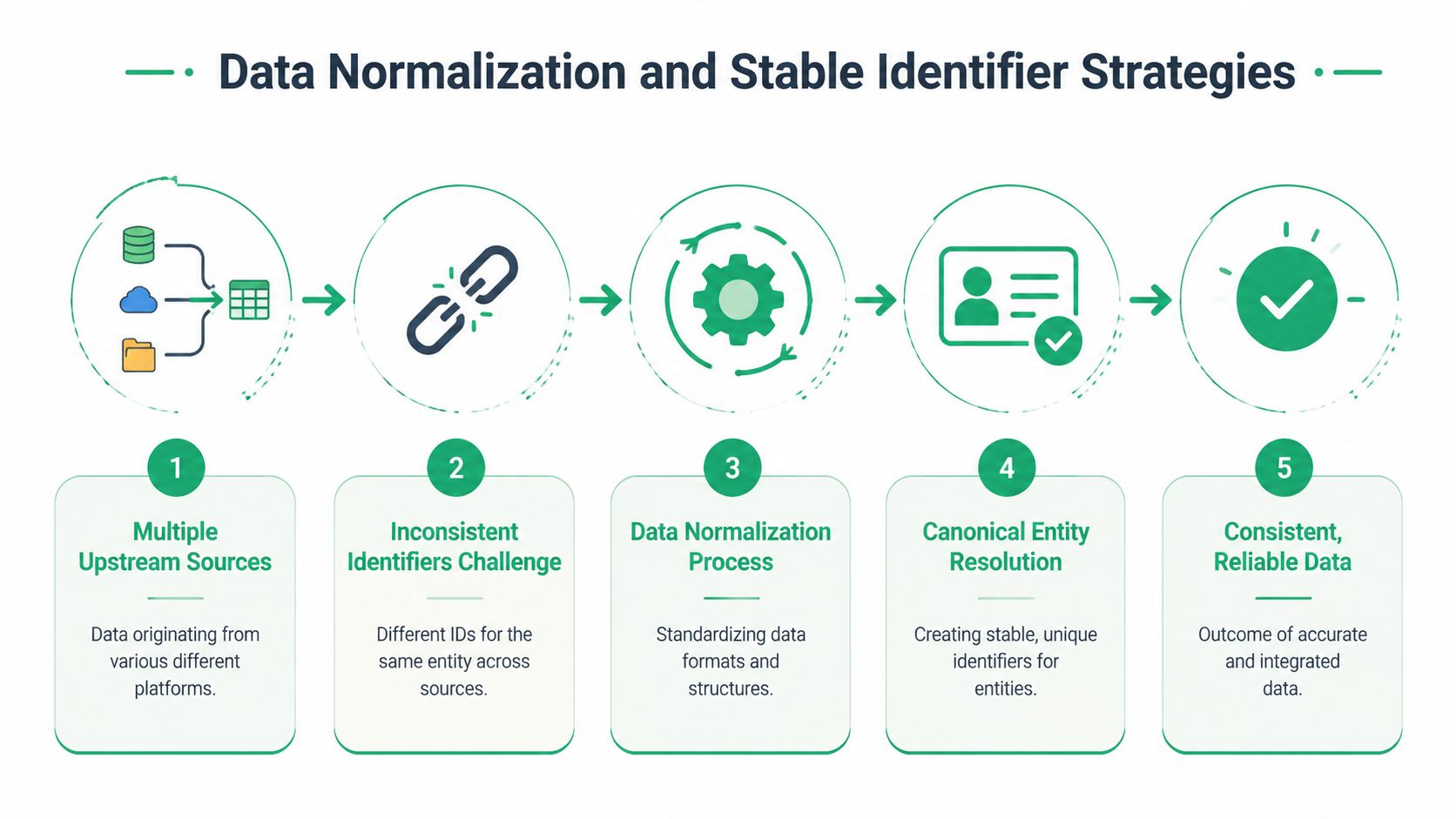
Normalization failures are rarely loud. The feed usually doesn't throw an error, it just stops joining the right records. That's why the most serious bug class in multi-source LoL integration is not odds math or metric calculation, it's entity resolution.
<a id="why-string-matching-fails"></a>
Why string matching fails
Unicode is where many pipelines break first. A documented best practice is to use Unicode normalization with case folding and alias lists, because names that look identical to a human can fail exact joins in code, including forms such as “Honved” and “Honvéd” as described in the normalization reference. In practical terms, a team name should be normalized before matching, not trusted as received.
The internal fix is a canonical entity layer. Every team, player, match, and tournament gets one stable UUID primary key, and all aliases map back to that record. Once that exists, upstream names become input to resolve, not keys to trust. That's the only reliable way to survive transliteration differences, tag changes, and rebrands without silent duplication.
<a id="how-reconciliation-should-work"></a>
How reconciliation should work
Entity resolution is usually a multi-step process, not one comparison. Standardize the text, block likely candidates, compare within the block, then resolve to one internal record. The research literature on entity resolution treats this as preprocessing, blocking, and matching, which maps neatly to feed design because you need a deterministic route from messy inputs to published rows for the multi-step framing.
Operational rule: never publish a reconciled line if you've only got one contributing source and no clear resolution path. Multiple independent inputs are what let you spot a bad join before it reaches users.
On the odds side, the practical safeguard is a minimum of two independent contributing sources before a line is published at all. That rule prevents a single malformed upstream record from becoming a false truth in the downstream feed. It also gives the health checks something concrete to verify, which matters more than pretty dashboards when something breaks overnight.
The same logic applies to hourly checks and daily data-quality digests. If the feed flags mis-resolved matches, score disagreements, or anomalous stat lines early, you can fix the pipeline instead of triaging unexplained gaps after the fact.
<a id="use-cases-for-lol-pro-stats-data-feed"></a>
Use Cases for LoL Pro Stats Data Feed
Different users care about different layers of the feed, and the cleanest integrations respect that split. Analytics teams want repeatable time series. Fantasy platforms want fast player scoring. Quant teams want a historical record they can replay without hidden survivorship bias.
<a id="analytics-workflows"></a>
Analytics workflows
For analytics, the most useful pattern is a snapshot plus event-stream pairing. The snapshot answers “what was true at this moment,” while the stream answers “what changed between now and then.” That lets an analyst plot patch-era trends, compare team tempo, or build dashboards that show how a match evolved rather than just how it ended.
The strongest feeds keep append-only odds history so model builders can reconstruct market conditions at any moment and avoid survivorship bias in backtests as noted in the history-focused industry discussion. That same structural idea applies cleanly to stat feeds, because time-ordered event logs make it possible to replay a match exactly as it looked at a prior point in time.
<a id="fantasy-and-scoring-workflows"></a>
Fantasy and scoring workflows
Fantasy systems care about deterministic scoring logic. That means stable player IDs, consistent stat definitions, and no guesswork around rosters. If a player switches tags or moves teams, the fantasy layer should still attach to the same internal entity and just update the label.
The feed doesn't need to invent a fantasy model. It needs to deliver reliable primitives so the application layer can decide how to score kills, assists, objectives, or vision impact. When that foundation is clean, the scoring engine stays maintainable and the product team can adjust rules without remapping the whole dataset.
<a id="quant-and-replay-workflows"></a>
Quant and replay workflows
Quant teams need something more demanding, a feed that can replay history without gaps. That's where append-only storage, timestamped updates, and stable IDs all matter at once. If a market or match correction arrives late, the model should still be able to inspect the old state and the revised state separately.
For an esports data feed, that's the difference between a useful research dataset and a brittle live feed. One supports backtesting, signal validation, and anomaly detection. The other only tells you what happened right now.
<a id="best-practices-for-integration-and-visualization"></a>
Best Practices for Integration and Visualization
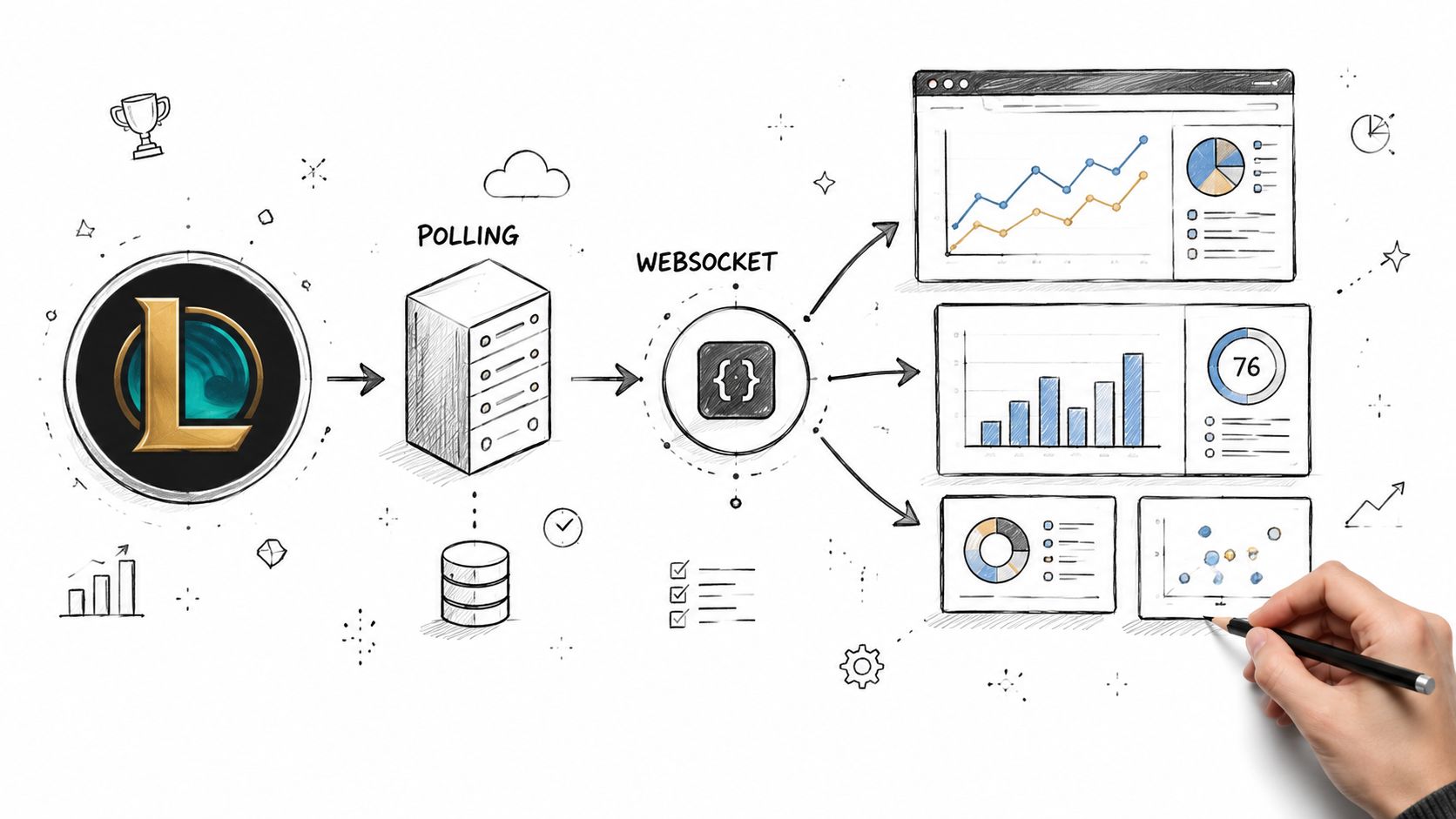
The best integrations combine polling and push notifications instead of choosing one or the other. Polling is still useful for catching missed changes and refreshing reference data. WebSockets are better for event-driven updates when the live state changes quickly.
<a id="integration-patterns-that-stay-stable"></a>
Integration patterns that stay stable
Use polling for discovery, then switch to targeted fetches when the stream says something changed. That reduces redundant calls and keeps the client from hammering the API for no reason. Static tables, such as teams and tournaments, should be cached aggressively because they change far less often than live match state.
Error handling should be explicit. Retry transient failures, surface schema mismatches separately, and treat missing data as a signal rather than covertly substituting zeroes. A bad fallback often looks cleaner on a chart, but it creates harder problems downstream.
One practical option for teams that want a supported, self-serve CS2 baseline while they build their own dashboards is EsportsOdds, which exposes normalized matches, teams, players, tournaments, and a reconciled market line through REST and a WebSocket update stream.
<a id="visualization-choices-that-fit-the-data"></a>
Visualization choices that fit the data
For time series, line charts are still the right default because they show movement clearly. For objective control, heatmaps work better because they surface concentration and timing patterns without flattening everything into one trend line. Leaderboards should stay interactive, with filters for roster, side, tournament, and date range.
A simple binding flow keeps the front end readable:
- Pull the current match snapshot.
- Subscribe to live updates.
- Re-render only the affected panel.
- Keep historical charts separate from live state widgets.
That separation matters because live state and retrospective analysis don't age the same way. If you mix them too tightly, the dashboard becomes hard to trust the moment a late correction lands.
<a id="cross-references-and-data-dependencies"></a>
Cross References and Data Dependencies
The feed only feels simple from the outside. In practice, match records, team records, player records, and derived indicators all depend on each other through stable IDs and foreign keys. If the team ID changes, roster snapshots break. If the match ID is unstable, event history loses its anchor.
Match endpoints should expose team and player references, while team records should point to roster snapshots that preserve season context. Derived indicators should always tie back to the base metrics that produced them, so users can trace a number all the way to its source events. That traceability is what lets schema consumers validate data instead of guessing.
When traversing the graph, fetch the parent object first, then hydrate the related resources you need. That pattern keeps latency down and avoids runaway rate-limit usage from over-fetching every related object in one pass. It also makes your client logic easier to debug because the dependency chain is visible, not implied.
<a id="quick-reference-tables-for-metrics-and-endpoints"></a>
Quick Reference Tables for Metrics and Endpoints
<a id="quick-reference-of-endpoints-and-metrics"></a>
Quick Reference of Endpoints and Metrics
| Endpoint | Description | Key Parameters | Primary Metrics |
|---|---|---|---|
/v1/lol/matches | Match list and match detail | date filters, tournament filters, pagination | duration, objectives, outcomes |
/v1/lol/teams | Team profiles and roster-linked records | team ID, tournament ID, page | win state, roster context, team aggregates |
/v1/lol/players | Player profiles and season aggregates | player ID, date range, sort | kills, assists, creep score, damage, vision |
/v1/lol/tournaments | Tournament context and bracket metadata | tournament ID, season, page | event context, bracket state, match references |
<a id="stable-identifier-fields"></a>
Stable Identifier Fields
| Entity | Stable Field | Purpose | Alias Handling |
|---|---|---|---|
| Match | UUID primary key | anchors match history | internal aliases only |
| Team | UUID primary key | keeps roster and season joins stable | multiple name forms map here |
| Player | UUID primary key | preserves career continuity | tag changes resolve here |
| Tournament | UUID primary key | keeps event context consistent | bracket labels map here |
These tables are most useful when you're debugging joins. If a row looks wrong, start with the identifier column before you inspect the metric math.
<a id="related-resources-and-glossary"></a>
Related Resources and Glossary
For deeper implementation work, use the schema registry, JSON Schema definitions, and endpoint docs together instead of treating them as separate sources of truth. If you're comparing data vendors or building a multi-provider stack, the broader guide to esports data API alternatives is useful for framing trade-offs between coverage, delivery style, and normalization depth. For a closely related normalization pattern in another competitive title, the Counter-Strike normalization guide shows how the same entity-resolution principles hold up across domains.
Canonical entity layer, the internal record that all aliases and source variants map to.
Unicode normalization, a text standardization step that makes visually similar strings comparable in code.
Append-only history, a storage pattern where every change becomes a new record instead of overwriting the old one.
Event stream, the live sequence of updates that tells clients what changed.
Snapshot model, the normalized current-state view that clients can query on demand.
Use the glossary when a payload looks right but behaves wrong. In feed work, those two things aren't always the same.
If you're planning a production LoL stats integration, start by auditing how your current pipeline handles IDs, aliases, and replayable history, then compare that against the schema and delivery model you need. Review the docs, test one match end to end, and wire your dashboard or model only after you've proven the joins stay stable under real upstream variation.