
Most advice about esports live stats starts with the wrong promise. It treats every match event like a clean, continuous stream that should appear on screen instantly, with no gaps, no reconciliation, and no trade-offs. In production, that mindset creates fragile systems. The better question is simpler, how do you deliver data that people can trust when the underlying game, market, and broadcast layers all move at different speeds?
For CS2, the practical answer is usually not “truly instant.” Match, player, and tournament stats can be refreshed every few minutes rather than instantly, and that cadence is often the right choice for structured data that has to survive normalization, validation, and delivery without breaking downstream apps EsportsOdds live data docs. The industry itself is large enough to justify that discipline, too, with global esports revenue at approximately $5.34 billion in 2026 and viewership at 640.8 million worldwide, including 56% mobile access SQ Magazine esports statistics. At that scale, the goal isn't vanity latency. It's dependable data flow.
Table of Contents
- What Esports Live Stats Really Means
- The Journey of Data from Game to Screen
- The Critical Challenge of Data Normalization
- Polling vs WebSockets for Data Delivery
- Common Use Cases for Esports Data APIs
- Building a Reliable Data Integration
<a id="what-esports-live-stats-really-means"></a>
What Esports Live Stats Really Means
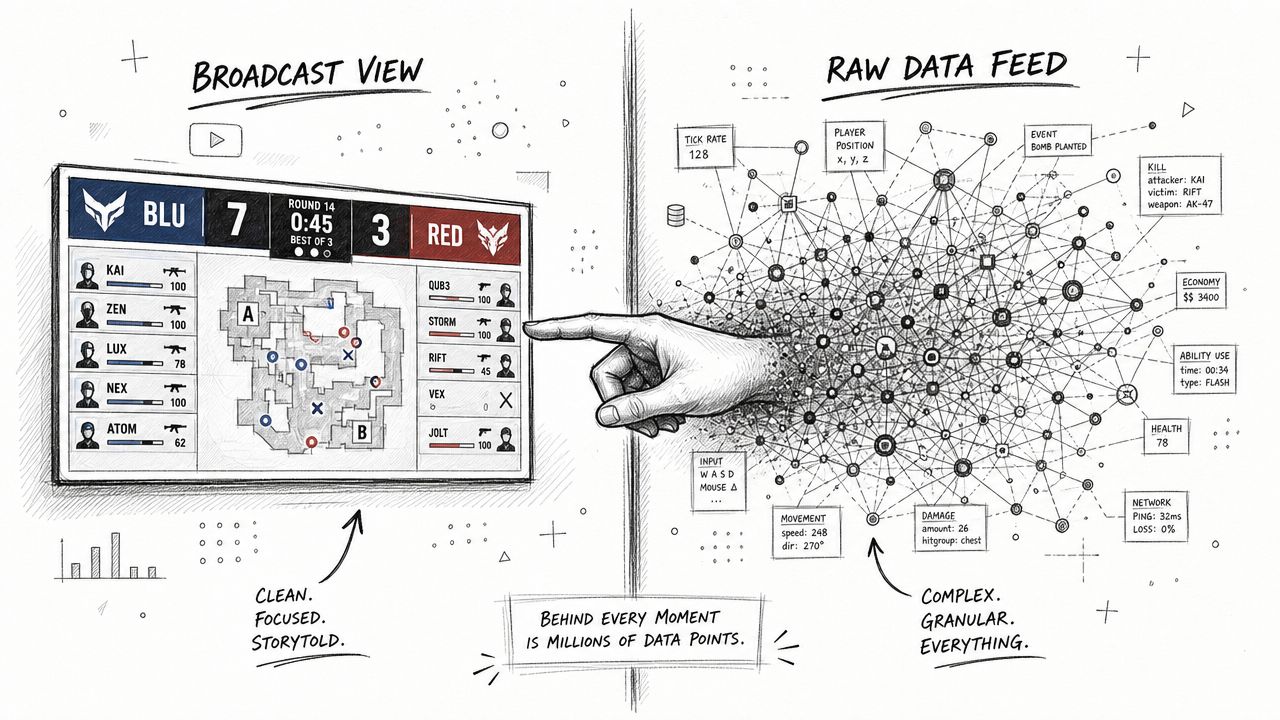
“Live” means different things depending on who consumes the data. A broadcast overlay can look immediate because it only shows a narrow slice of the match. A production API has a harder job. It has to return stable objects, consistent identifiers, and fields that do not break when a score is disputed or when the same team name appears in more than one form.
<a id="live-on-screen-is-not-the-same-as-live-in-a-production-api"></a>
Live on screen is not the same as live in a production API
A viewer usually wants freshness and speed. A developer wants a feed that stays correct after it is cached, queried, merged, and rendered in several places. Those goals overlap, but they are not identical, and that is where a lot of “instant stats” language becomes misleading.
For CS2, the practical pattern is structured refreshes, not an endless stream of atomic events. EsportsOdds' documented cadence for CS2 match results and per-map player stats is about 5 to 7 minutes, so the data refreshes as results land per map or after the match rather than as a continuous firehose (odds are re-priced about once a minute while a market is open, and the docs publish measured freshness percentiles) EsportsOdds live data docs. That trade-off is deliberate. It gives downstream systems a predictable rhythm for processing changes, and it avoids pretending that every consumer needs raw event-level immediacy.
If you need to pull match data into your own stack, the CS2 match data guide shows how that kind of feed fits into a real integration.
Practical rule: if a stat has to survive into a dashboard, model, or archive, treat consistency as a feature and raw immediacy as a cost center.
<a id="why-production-teams-should-prefer-trustworthy-refreshes"></a>
Why production teams should prefer trustworthy refreshes
The audience mix makes this harder, not easier. With global viewership measured in the hundreds of millions and a large share of viewers on mobile, the delivery layer has to tolerate inconsistent networks, devices, and screen sizes SQ Magazine esports statistics. A consumer may never see every internal update, but they do need the final state to be coherent.
The strongest systems separate display urgency from data certainty. They let front ends react quickly while the backend keeps the schema clean, the identifiers stable, and the update cadence predictable. That is the point where “live stats” stops being a marketing shortcut and becomes a product term that describes what the system can guarantee.
<a id="the-journey-of-data-from-game-to-screen"></a>
The Journey of Data from Game to Screen
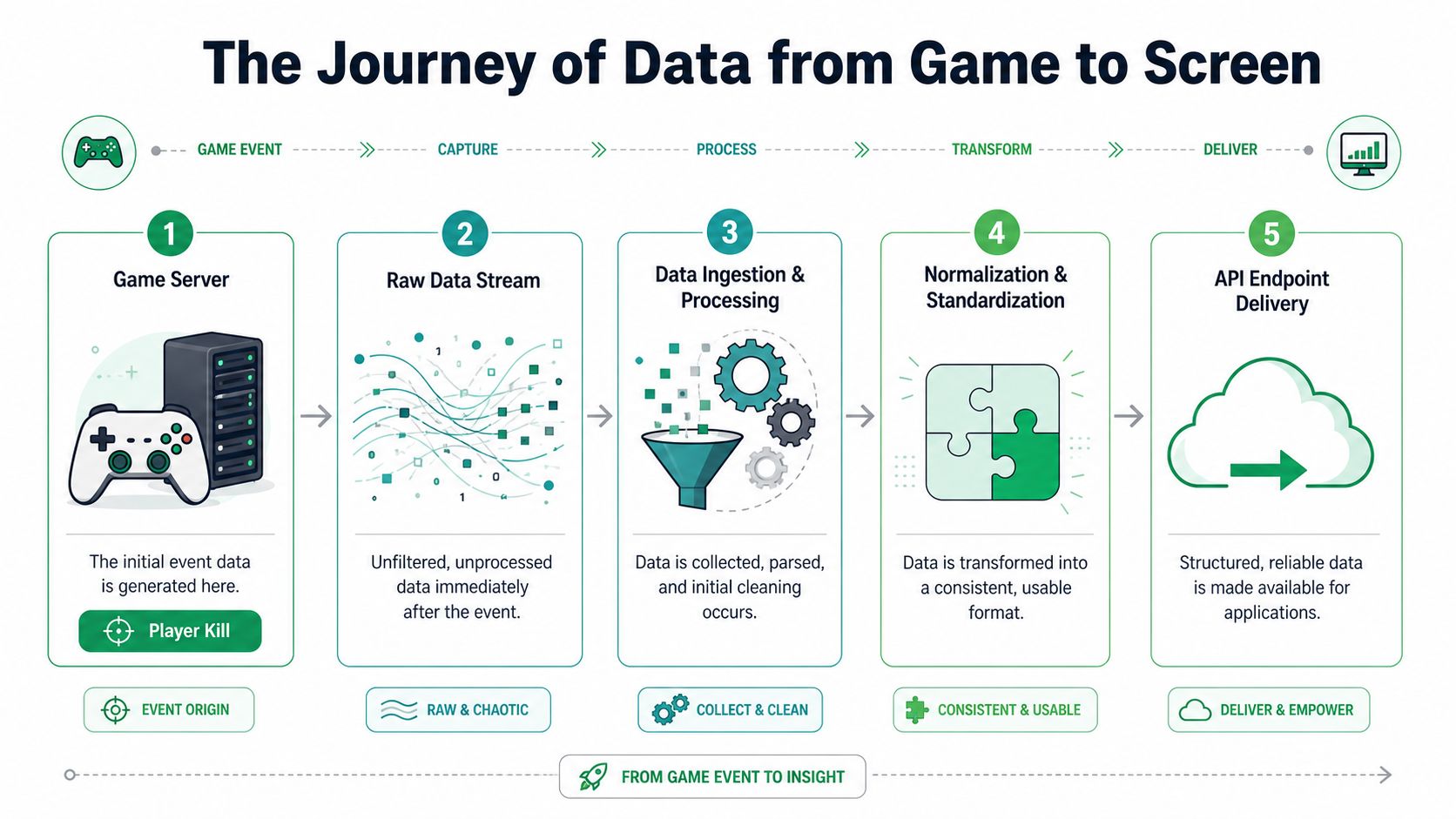
A single kill in CS2 can look trivial from the outside. Inside the pipeline, it passes through several systems before it becomes a number a client can trust. If one stage is weak, the final result can be late, duplicated, or inconsistent.
<a id="from-event-generation-to-structured-delivery"></a>
From event generation to structured delivery
The sequence is straightforward in concept, even if the implementation is messy. First, the game server produces the event. Then ingestion services capture it, process it, normalize it, and make it available through an API endpoint. A reliable pipeline has to preserve meaning at every handoff, not just move bytes around.
In practice, scalable delivery usually starts with streaming ingestion, not batch jobs. Apache Kafka or AWS Kinesis handle the event flow, Redis serves hot reads, Apache Flink helps unify feed formats, and WebSocket or Server-Sent Events push updates to clients without repeated polling Tencent Cloud techpedia. That architecture exists because latency-sensitive apps punish delays at every layer.
The key trade-off is simple. Batch processing is easier to reason about, but it creates stale results. Streaming is harder to engineer, but it keeps the system responsive enough for match-driven applications.
<a id="why-the-pipeline-needs-guardrails"></a>
Why the pipeline needs guardrails
A supply chain works because each checkpoint verifies the shipment before it moves on. Esports data needs the same discipline. If a team name arrives in the wrong format, or a match record appears twice, the issue has to be caught before it reaches the API consumer.
That's why practical systems separate capture from publication. They can accept raw events quickly, then enforce structure before the data becomes visible. If you want to dig deeper into that data shape for CS2, the integration path is documented in the CS2 match data pull guide. The important part is that every stage has a job, and none of them should pretend to be the final source of truth.
<a id="the-critical-challenge-of-data-normalization"></a>
The Critical Challenge of Data Normalization
Raw esports feeds are messy because the same real-world object can arrive in multiple forms. A team name may appear with or without diacritics. A match can be recorded twice under slightly different bracket paths. A score can disagree across sources until one version is corrected.
<a id="normalization-is-not-cleanup-its-product-logic"></a>
Normalization is not cleanup, it's product logic
A production API cannot treat “Honved” and “Honvéd” as separate teams if the rest of the system expects one stable identity. Unicode handling matters because that small mismatch breaks joins, rosters, and historical lookup tables. The same applies to player names, tournament labels, and imported bracket structures.
Normalization also has to reconcile the parts humans notice first. Half scores, overtime scores, and winner-vs-score disagreements all need explicit rules. If one source says a map ended 13-11 and another shows a different final state, the system should flag the conflict instead of guessing. That is not an edge case, it is basic data hygiene.
Rule of thumb: if a field can affect a leaderboard, a settlement flow, or a historical replay, it needs deterministic reconciliation before publication.
<a id="append-only-history-matters-more-than-raw-freshness"></a>
Append-only history matters more than raw freshness
Odds create a different normalization problem. Many dashboards show the current line, but they hide the append-only movement that explains why the line changed in the first place. That missing tick history makes backtesting weak, because quant teams cannot reliably replay the exact sequence of market reactions without every timestamped change. The engineering pattern behind official live data is discussed in Esports Insider on official live data, and the trade-off is the same across sports feeds, freshness is only useful if the historical trail is still there.
EsportsOdds handles this by publishing a single de-vigged aggregate line whose implied probabilities sum to exactly 100%, while retaining the full history internally and avoiding individual bookmaker prices or public bookmaker names. That approach gives downstream consumers one reconciled view instead of a pile of conflicting inputs. It is a practical choice, because production systems need a stable snapshot and a traceable audit trail at the same time.
<a id="what-breaks-when-normalization-is-rushed"></a>
What breaks when normalization is rushed
- Name collisions: one player appears under different spellings, so history fragments.
- Bracket drift: duplicated match rows make the schedule look larger than it is.
- Score conflicts: the dashboard flips between versions and loses trust.
- Odds ambiguity: a line moves, but nobody can tell whether the move came from match state or risk management.
The normalization notes in the CS2 data normalization guide are more useful than a generic data quality checklist because they focus on the actual reconciliation problems that show up in CS2 feeds. Normalization is not a back-office afterthought. It is the layer that makes esports data usable at all.
<a id="polling-vs-websockets-for-data-delivery"></a>
Polling vs WebSockets for Data Delivery
The delivery choice shapes both the user experience and the operating cost. Polling asks the server for updates on a schedule. WebSockets keep a persistent connection open and let the server push notice when something changes. Neither is perfect, and most production systems benefit from using both in different places.
<a id="comparison-table"></a>
Comparison table
| Attribute | Polling (REST API) | Push (WebSocket) |
|---|---|---|
| Connection model | Repeated requests | Persistent connection |
| Bandwidth use | Higher when updates are sparse | Lower when updates are event-driven |
| Implementation complexity | Simpler | More moving parts |
| Freshness pattern | Best for scheduled refreshes | Best for update notifications |
| Failure behavior | Easy to retry per request | Needs reconnect logic |
| Best fit | Structured reads and reconciliation | Client alerts and change detection |
<a id="what-each-method-does-well"></a>
What each method does well
Polling is boring in the best way. It's easy to debug, easy to cache, and easy to reason about when a client only needs updates on a predictable cadence. That's why a steady polling cycle of a few minutes works so well for many CS2 stat fields, especially when the data lands per map or post-match rather than as a continuous event firehose.
WebSockets are better when the client needs to know that something changed right now, without burning bandwidth on constant repeat requests. That matters in esports because the underlying timing can be strict. Esports live stat pipelines require sub-20ms RTT and packet loss below 1% to avoid desynchronization, and a 10ms increase in RTT can correlate with a 5-7% reduction in reaction accuracy for fast-twitch actions in Counter-Strike 2 Inflect on esports infrastructure. The data layer won't always match gameplay speed, but it still has to respect the latency sensitivity of the use case.
Practical takeaway: use push to signal change, then pull the structured resource you actually need.
That hybrid pattern keeps front ends responsive without turning every client into a constant poller. If you're wiring up a CS2 dashboard, the WebSocket update flow guide is the right reference point for the notification side of the integration.
<a id="common-use-cases-for-esports-data-apis"></a>
Common Use Cases for Esports Data APIs
Different teams consume the same pipeline in different ways. Media sites care about visible freshness. Fantasy and prediction products care about correct results. Quant teams care about the full time series, especially when a market moves and nobody can explain why.
<a id="media-fantasy-and-quantitative-workflows"></a>
Media, fantasy, and quantitative workflows
Media publishers usually need match state, player output, and tournament context on a display that does not blink or contradict itself. The value comes from trust, because viewers spot bad scoreboards immediately. A stable API matters more than a flashy one.
Fantasy and prediction platforms need reliable schedules and finalized results. If a match is misresolved, the downstream impact shows up in standings, settlement, and user support. That is why the reconciliation layer matters more than surface speed.
Quant teams are the most demanding consumers. They need timestamped history, not just the last known line. Without append-only capture, they cannot study drift, tie line changes to in-game events, or replay market behavior with confidence.
<a id="what-reliable-data-enables"></a>
What Reliable Data Enables
- Media products: cleaner overlays, fewer refresh errors, and less manual correction.
- Prediction tools: stronger contest settlement and fewer disputes.
- Trading models: time-series analysis that preserves market movement instead of flattening it.
The common thread is that each use case rewards a different part of the pipeline. A display tool can tolerate more abstraction than a backtesting engine. A settlement engine can tolerate less ambiguity than a highlight page. That is why “esports live stats” is a broad label, but the engineering requirements underneath it are sharply different. Reliable feeds also depend on clear operational discipline, which is why Esports Insider on official live data is a useful reference point for the trade-off between instant updates and production-grade consistency.
<a id="building-a-reliable-data-integration"></a>
Building a Reliable Data Integration
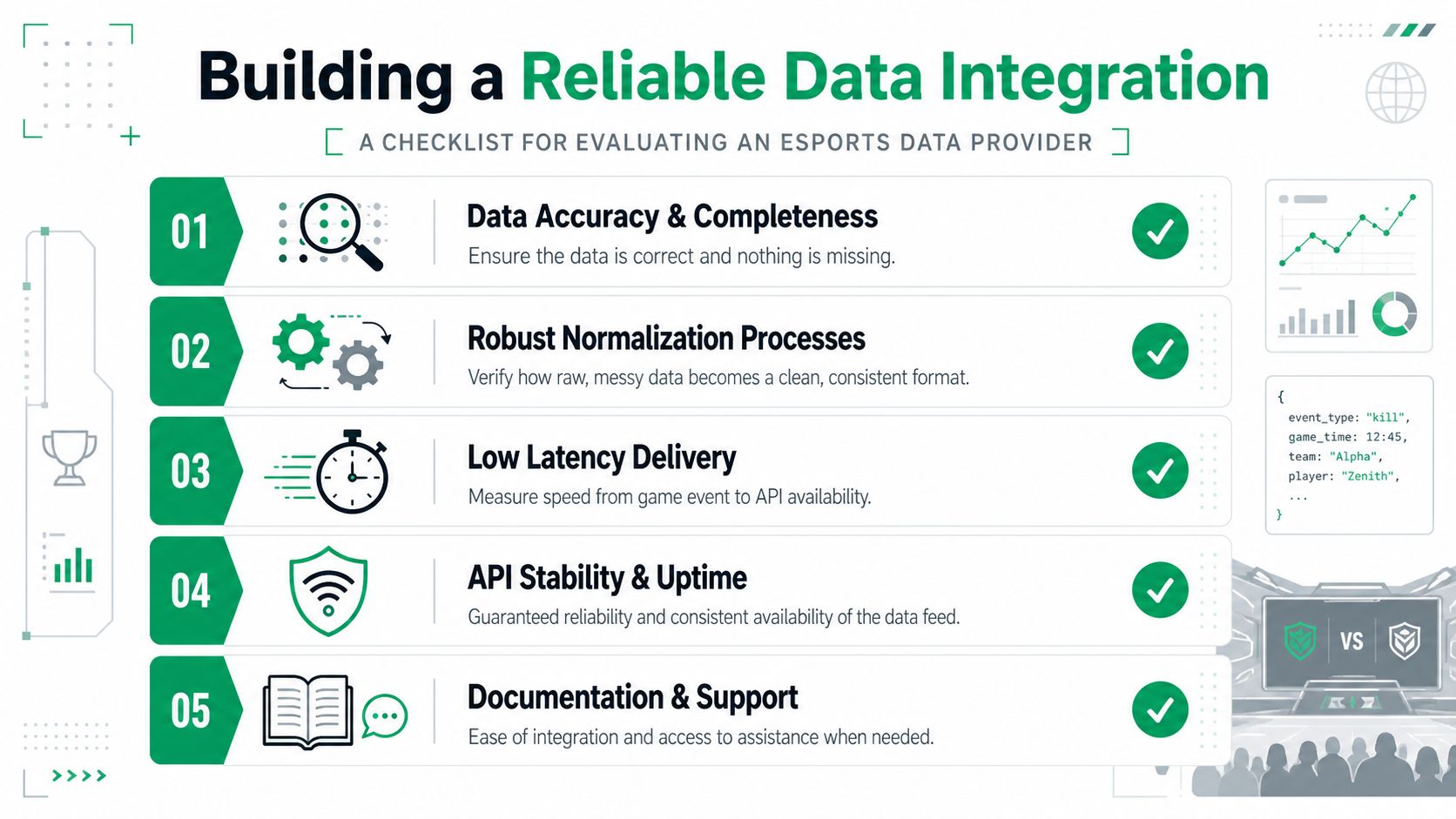
A reliable integration starts with the provider's habits, not just the endpoint list. Good documentation helps, but stable IDs, visible validation rules, and a clear policy for bad or missing data matter just as much. If a vendor cannot explain how it catches errors, your app becomes the fallback QA layer.
<a id="what-to-check-before-you-integrate"></a>
What to check before you integrate
Look for a schema that stays stable across events and seasons. Scrapers usually break at the seams, while a real API keeps identifiers consistent across matches, players, teams, and tournaments. You also want predictable update behavior, because your code will depend on whether changes arrive as push notifications, scheduled refreshes, or both.
Reliability should be visible, not implied. A useful provider runs automated health checks across the pipeline on a fixed schedule, then publishes data-quality reporting that flags mis-resolved matches, score disagreements, and anomalous stat lines. That kind of operational honesty is more useful than vague uptime claims.
A provider also has to make trade-offs clear. True live delivery is attractive, but periodic updates and post-match reconciliation often produce cleaner data for production systems. If your product needs stable overlays, settled outcomes, or historical analysis, a slightly slower feed with explicit correction rules can be the better choice.
<a id="a-practical-evaluation-checklist"></a>
A practical evaluation checklist
- Data accuracy and completeness: confirm the feed resolves matches cleanly and exposes missingness instead of hiding it.
- Normalization depth: check whether names, scores, and duplicate records are reconciled before the API response.
- Delivery model: decide whether you need polling, push notifications, or a hybrid setup.
- Operational transparency: ask for health checks, data-quality digests, and clear failure handling.
- Documentation quality: verify that endpoints, schemas, and refresh behavior are described in plain language.
The market keeps expanding, and the data layer has to keep up. Growth in esports activity raises the pressure on API design, which means low-latency, scalable delivery matters more as adoption grows. That growth does not reward the loudest product. It rewards the one that stays correct under load.
If you are choosing a CS2 data layer, start with your tolerance for bad data, stale updates, and unclear provenance. Then test the provider against those constraints with real match flows, not demo screenshots. If you want a developer-focused CS2 API with normalized match data, reconciled odds, and documented delivery behavior, review EsportsOdds and compare it against your integration requirements before you build.