CS2 Swiss format: pairings, tiebreaks and what 3-0 takes
, 6 min read
Reviewed by Phil McParlane, Founder, on
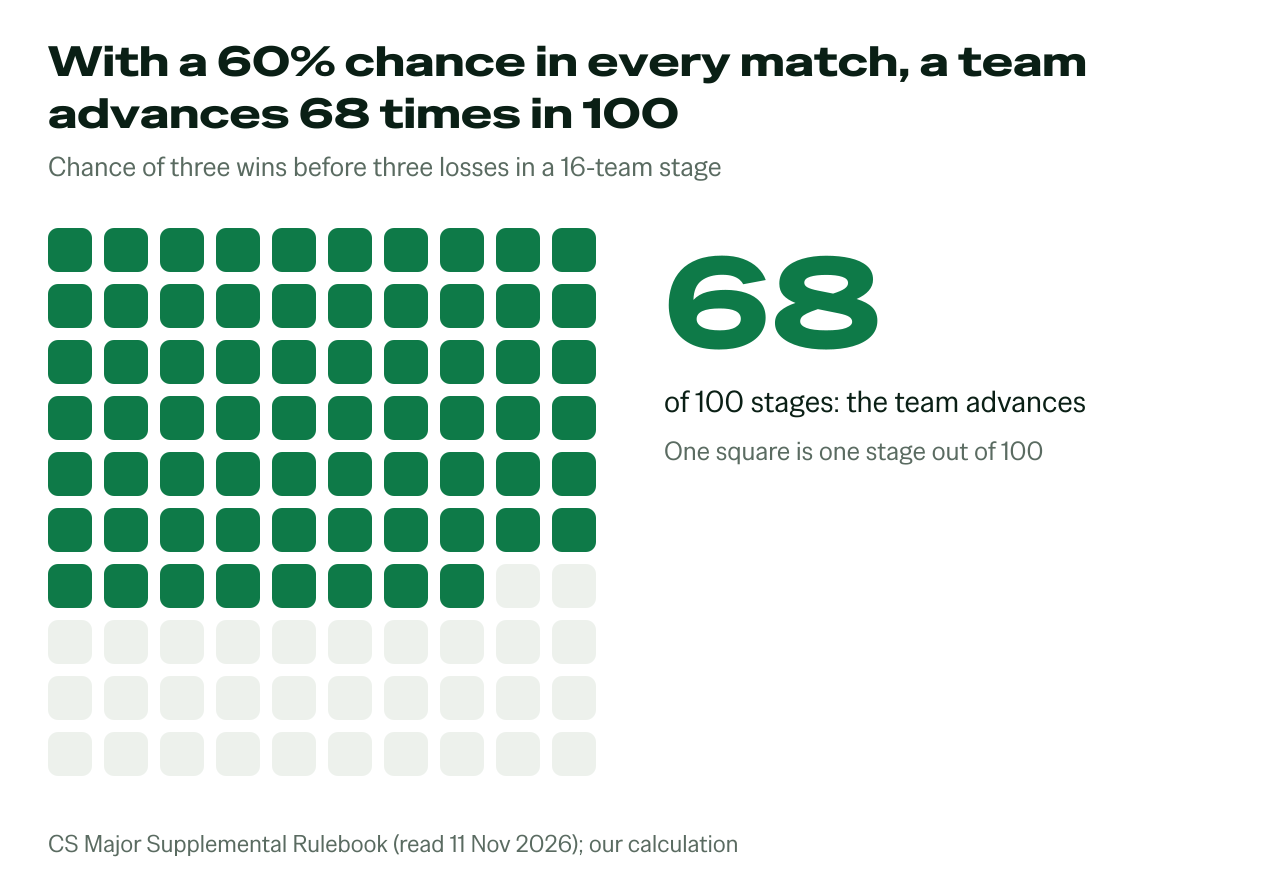
Bottom line: The CS2 Swiss format runs three 16-team stages at a Major. Teams on the same record play each other: three wins send a team through, and three losses end its run. By our count, a stage has five rounds and 33 matches. A made-up team with a 60% chance in every match advances in 68.3% of stages.
Five rounds, 33 matches: how a stage runs
Valve's CS Major Supplemental Rulebook sets the current format. A Major has 32 teams: 16 start in Stage 1, and 8 more join at each of Stages 2 and 3. Every stage runs the CS2 Swiss format with 16 teams. The top 8 from Stage 3 go to the playoffs.
In every round, teams meet opponents with the same win-loss record. Three wins advance a team, and three losses eliminate it. So nobody plays more than five matches, and a Swiss stage has five rounds.
The rulebook says elimination matches and advancement matches are best of three. Every other match is best of one. It does not define those two terms. We read them this way: a match is best of three when either team already has two wins or two losses.
| Round | Teams by record | Matches | Best of three |
|---|---|---|---|
| 1 | 16 at 0-0 | 8 | 0 |
| 2 | 8 at 1-0, 8 at 0-1 | 8 | 0 |
| 3 | 4 at 2-0, 8 at 1-1, 4 at 0-2 | 8 | 4 |
| 4 | 6 at 2-1, 6 at 1-2 | 6 | 6 |
| 5 | 6 at 2-2 | 3 | 3 |
| Total | 33 | 13 |
That makes 20 of the 33 matches best of one and 13 best of three, under that reading. Every Swiss stage ends the same way: two teams finish 3-0, three finish 3-1 and three finish 3-2, and those 8 advance. Three finish 2-3, three finish 1-3 and two finish 0-3.
Who plays whom: seeds, round 1 and rematches
Pairings come from seeds. Before the event, the rulebook sorts all 32 teams by their current global standing in the Valve Regional Standing (VRS). Stage 1 uses that pre-event seed.
In Stages 2 and 3, the 8 teams invited straight in are seeds 1 to 8, by pre-event seed. The 8 teams moving up are seeds 9 to 16, by their final seed from the stage before. Seeds are numbered inside each stage.
Round 1 is fixed: seed 1 plays seed 9, 2 plays 10, and so on to 8 against 16. In rounds 2 and 3, the highest seed faces the lowest seed available that it has not already met in the stage.
Rounds 4 and 5 use a priority table of 15 rows: the pairings come from the top-most row with no rematch. The rulebook does not say what its numbers mean. We read them as seed order inside a group of six teams on the same record. So the top row, 1v6, 2v5 and 3v4, pairs highest with lowest. The rulebook adds: no rematches in a stage, if possible.
The tiebreak: Difficulty Score
After round 1, teams are seeded by win-loss record in the stage, then Difficulty Score, then initial seed. In Valve's rulebook, the Difficulty Score is labelled Buchholz. It adds up the current wins of every opponent a team has faced, then takes away their current losses.
The rulebook's example: Team A has faced teams on 2-0 and 1-1, which total 3 wins and 1 loss, so its score is 2. Team B has faced two teams on 1-1, which total 2 wins and 2 losses, so its score is 0. On the same record, Team A is seeded higher, because its opponents were harder to beat.
The playoffs use each team's final seed from Stage 3, worked out the same way.
What 3-0 takes, and how likely advancing is
The numbers here assume one fixed chance of winning every match, whoever the opponent and whatever the match length. No real team works like that, and nothing here forecasts any team. They show what the format does to a made-up team.
Advancing: a best-of-five race
Advancing means winning three matches before losing three. That is the same race as a best of five series, so the chance to advance equals the chance to win one.
| Chance to win each match | Goes 3-0 | Advances | Goes 0-3 |
|---|---|---|---|
| 40% | 6.4% | 31.7% | 21.6% |
| 50% | 12.5% | 50.0% | 12.5% |
| 60% | 21.6% | 68.3% | 6.4% |
| 70% | 34.3% | 83.7% | 2.7% |
| 80% | 51.2% | 94.2% | 0.8% |
A team with a 50% chance advances half the time. Even a 60% team goes out in 31.7% of stages.
Going 3-0
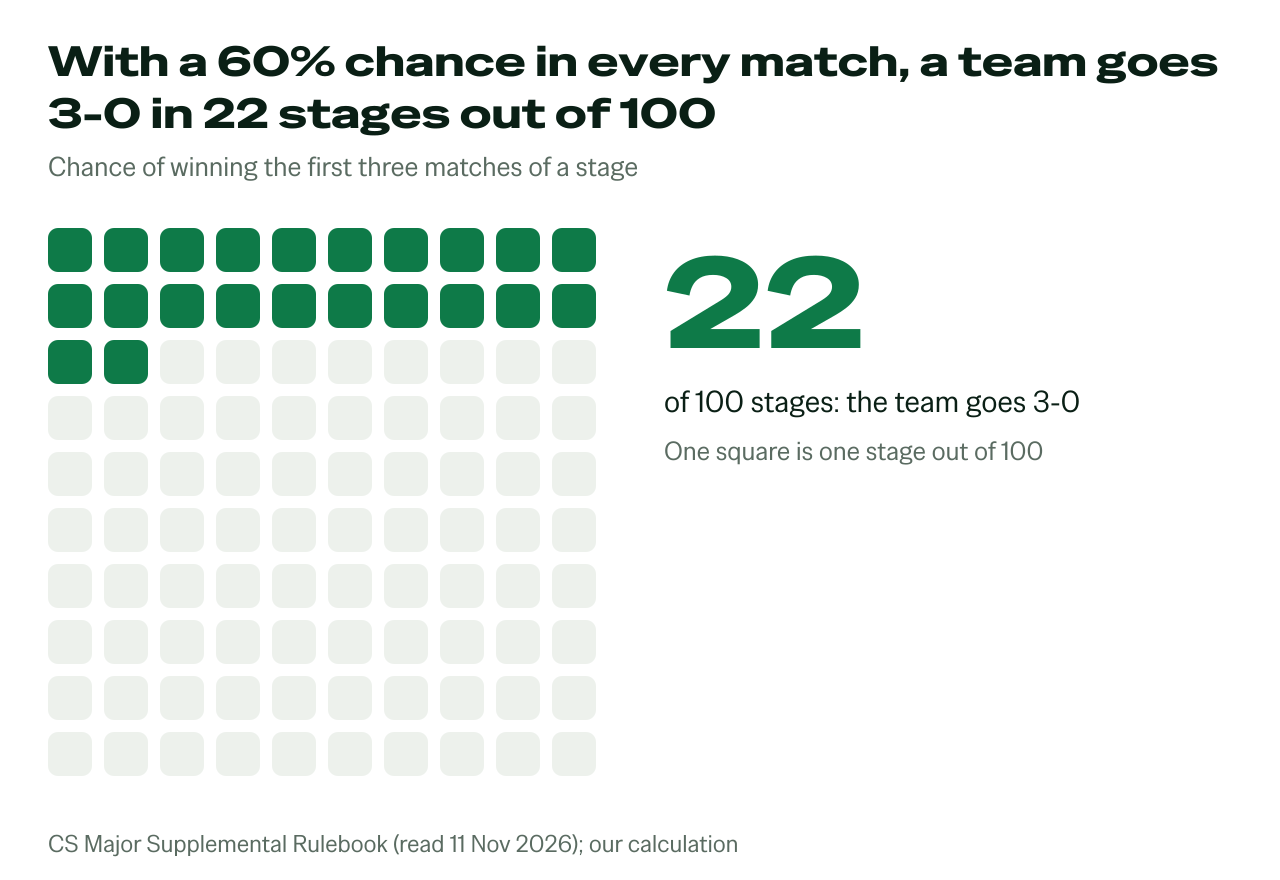
A 3-0 team wins three in a row and skips rounds 4 and 5. Rounds 1 and 2 are best of one. Round 3, against another 2-0 team, is best of three under that reading. At 60% per match, that happens in 21.6% of stages.
Match length changes the chance. Our series win probability calculator shows that when a team wins 60% of its maps, it wins 64.8% of best of three series and 68.3% of best of five series.
What one organiser announced
ESL announced that every match in Stage 3 at the IEM Cologne Major 2026 would be best of three. In a stage like that, all 33 matches are best of three. So the 20 and 13 hold under the rulebook's rules, not in every stage.
Where the rules come from
This page follows the CS Major Supplemental Rulebook that Valve publishes on GitHub. The rulebook says it covers only the rules Valve requires to be the same at every Major. On 11 November 2026, the rulebook's latest change was dated 6 October 2026. The counts and chances here are our own arithmetic from those rules. If you build tools around CS2 results, our CS2 data API covers fixtures, results and per-map scores.
Start free with a sandbox key: a fixed sample of past matches, no card.